Complexity management with product mining
Product Mining is a new, data-driven platform technology to make complexity management in manufacturing companies…
BLOG series Automated storage systems
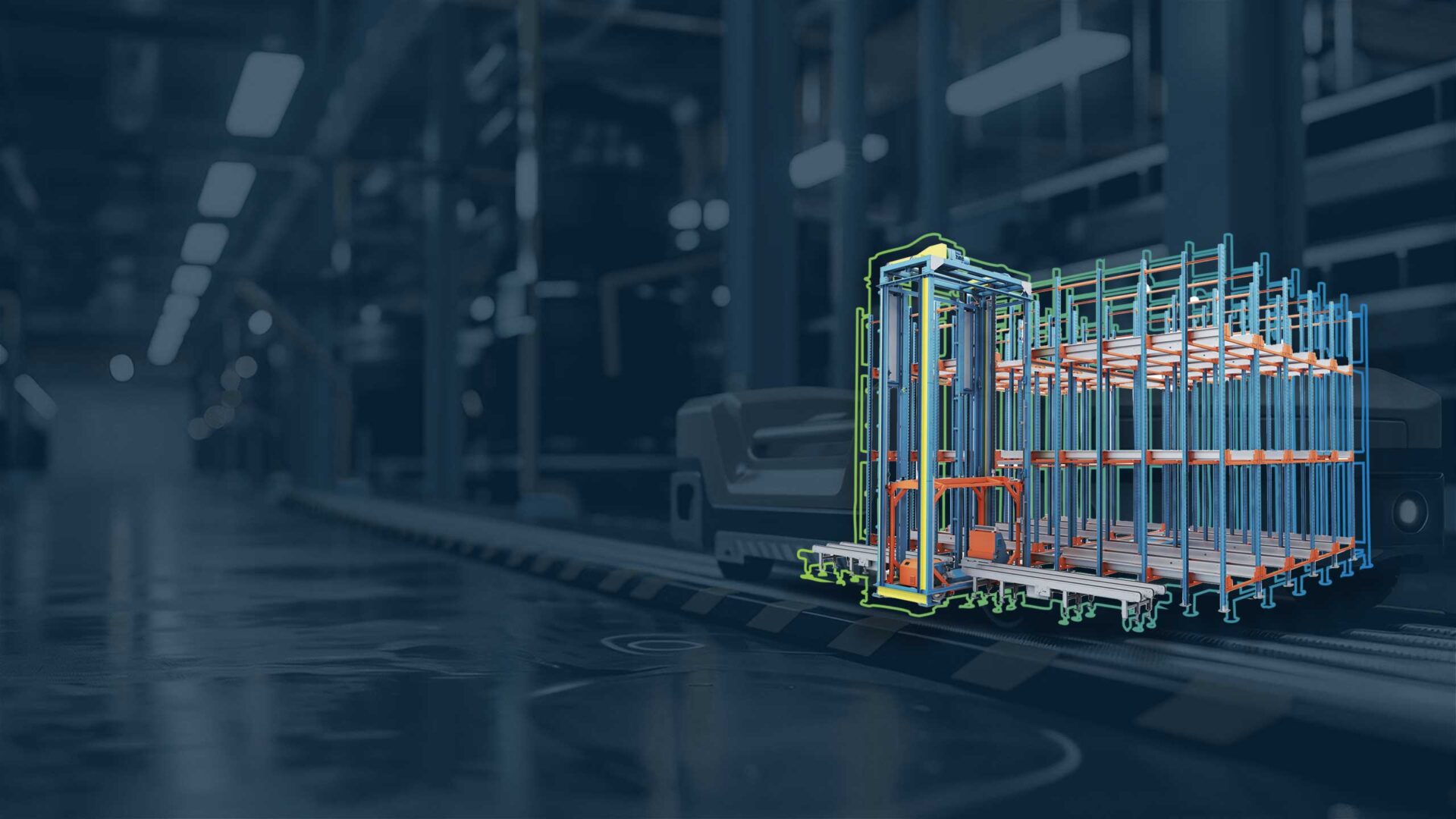
In this article in the series of blog articles on automated storage systems, we look at automated pallet warehouses. Automated pallet warehouses are becoming increasingly important in modern intralogistics. Increasing throughput requirements, limited space and the desire for greater process reliability are driving companies to automate their warehouse processes. Various technological solutions are available today that offer specific advantages depending on the application. This article provides an overview of the various types of automated pallet storage systems and highlights the technological differences between storage and retrieval machines, shuttle systems and automated guided vehicles.
Automated pallet warehouses are state-of-the-art storage systems that handle the storage of pallets fully or partially automatically. They increase efficiency, reduce errors and enable space-saving storage on several levels. There is a wide range of different systems. The following morphological box shows 5 variant-forming criteria with possible characteristics.
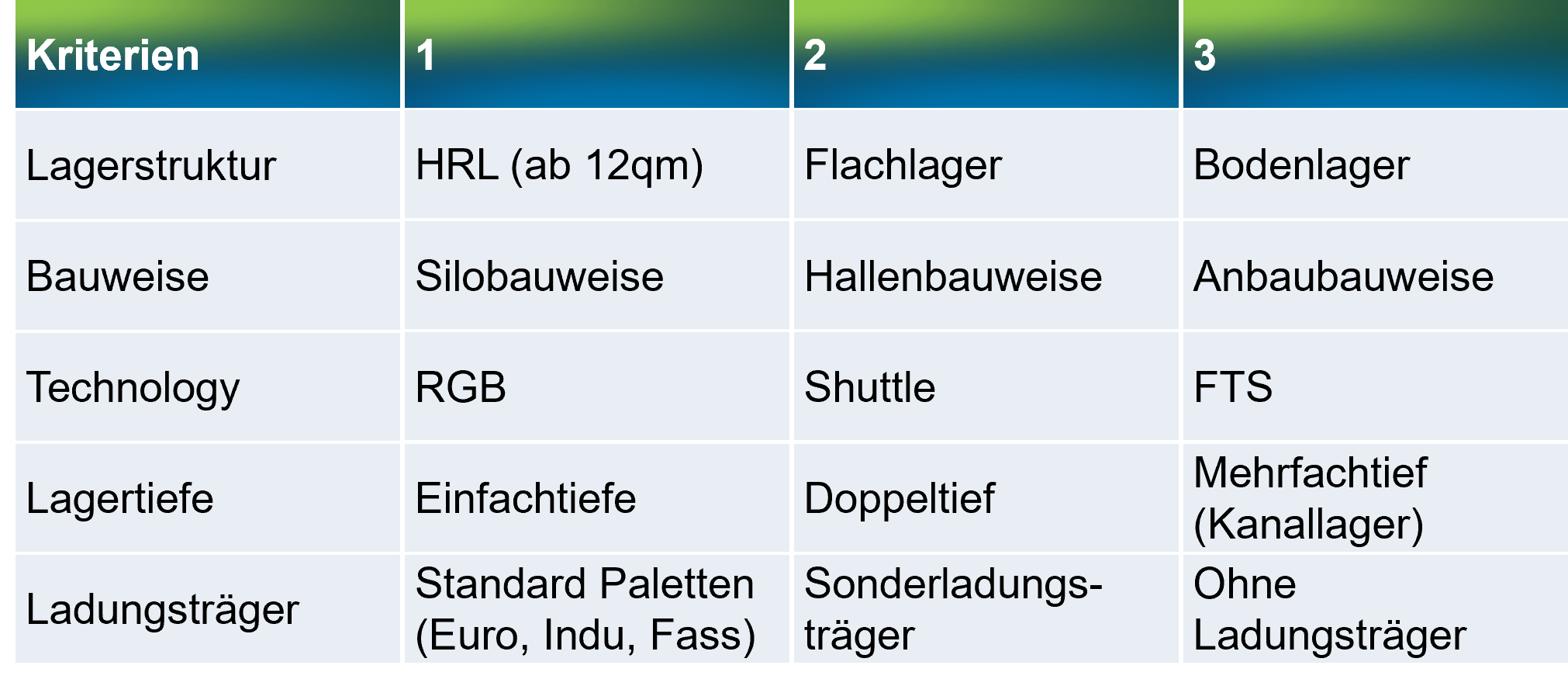
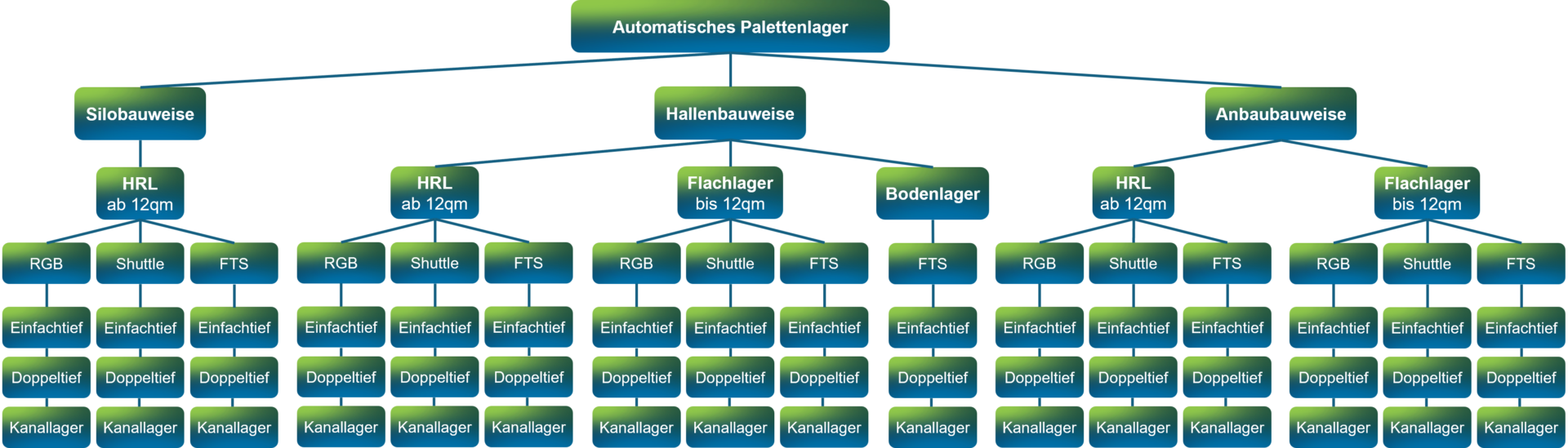
These criteria and design variants result in a wide range of options for designing an automated pallet warehouse. Almost all combinations can be implemented, but which variants make technical and economic sense must be examined in great detail. Both the technical possibilities and the requirements of the company, such as stored goods, turnover frequency and available space, are relevant.

Senior Manager Logistics
Are you looking for a suitable automated storage system and need support? Send me your message and I will get back to you as soon as possible.
In this section, we will take a closer look at the differentiation by technology.
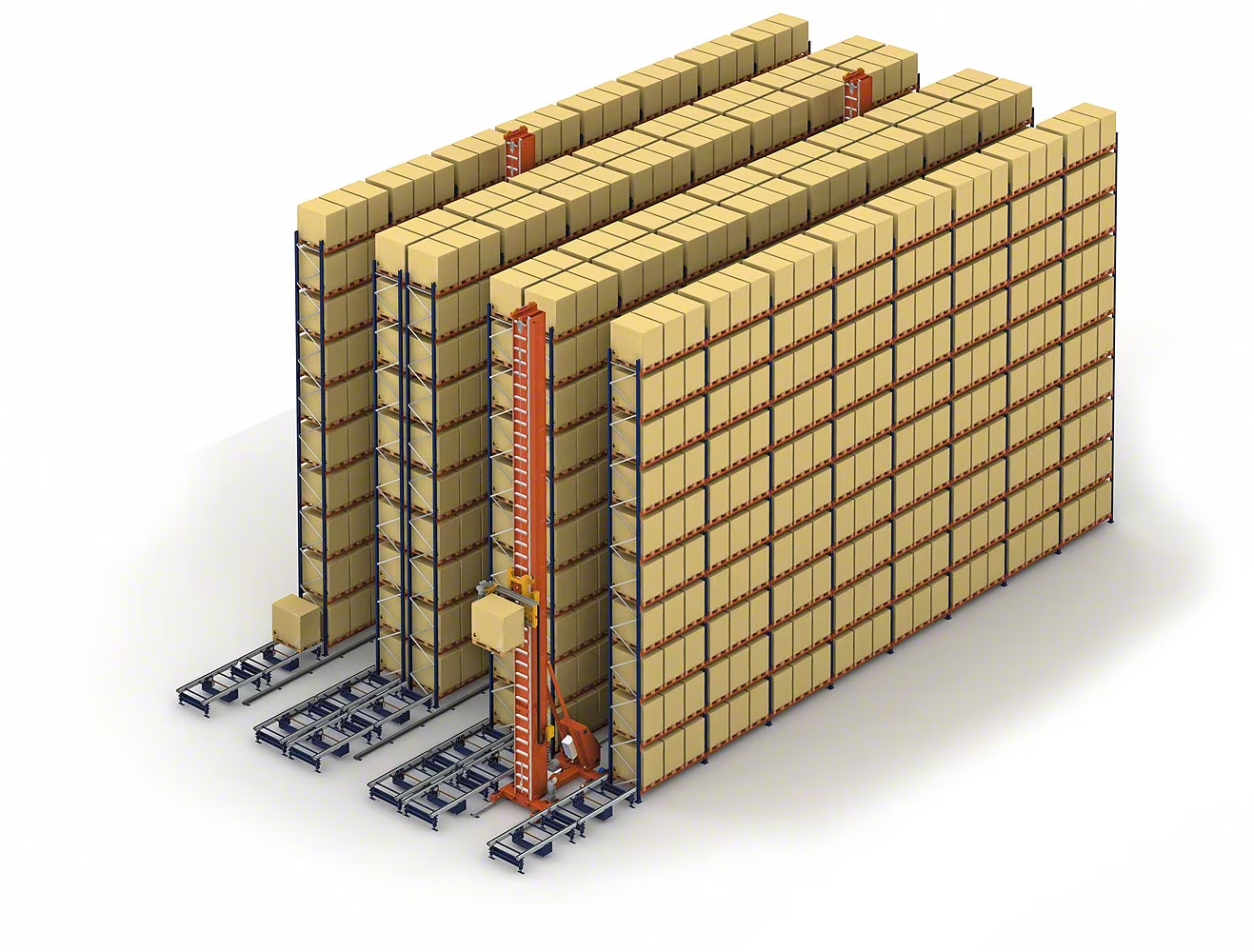
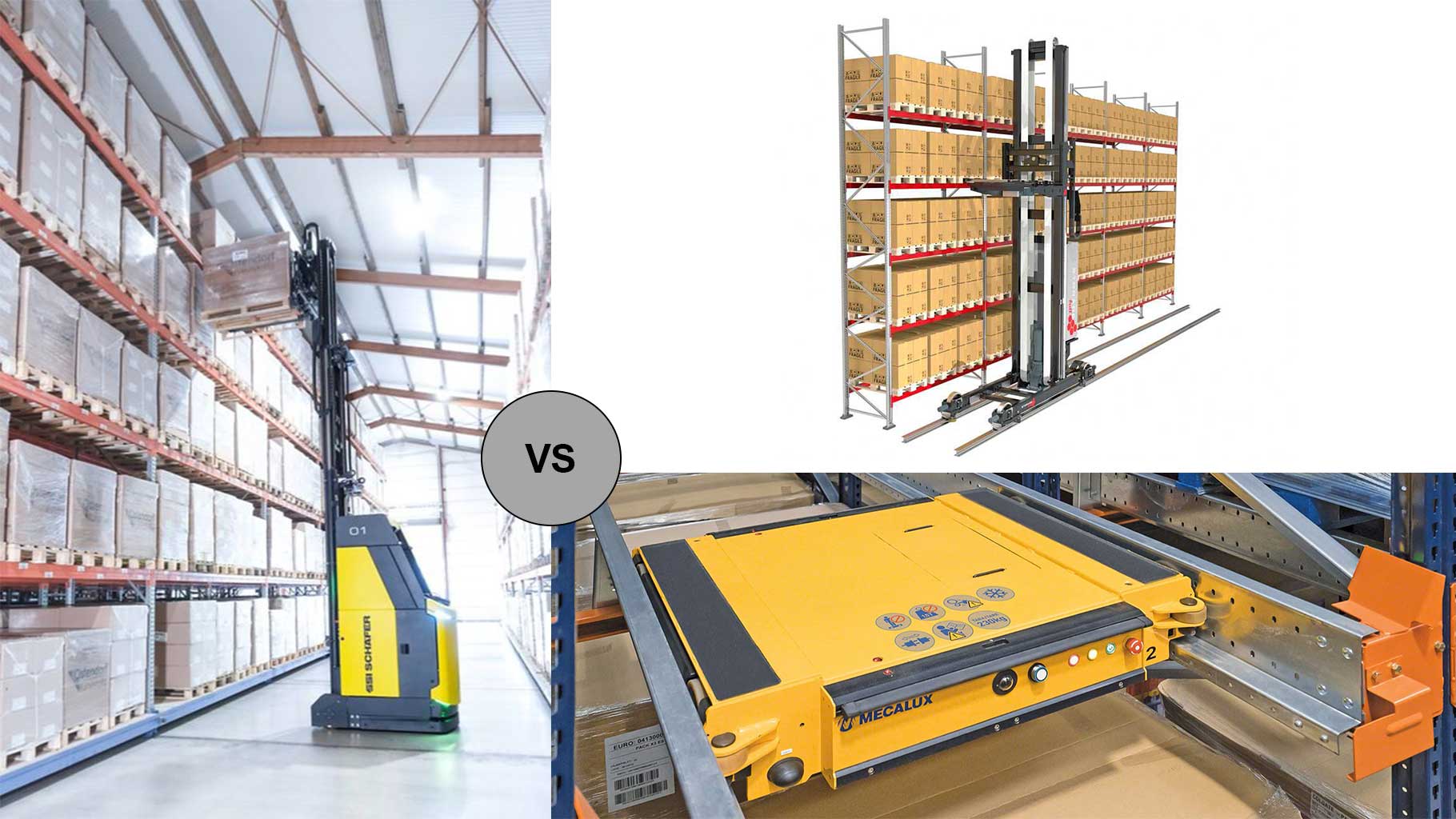
An automated pallet warehouse with storage and retrieval machines (SRMs) is a high-performance storage system for the fully automated storage and retrieval of pallets. SRMs move on permanently installed rails within the rack aisles and transport pallets precisely to defined storage locations. The RGB moves both horizontally and vertically. These systems enable a particularly high storage density on a small footprint, often with heights of up to 50 meters. Automated control significantly increases throughput and process reliability, while at the same time reducing error rates and personnel costs. SRM warehouses are ideal for a large variety of items and high turnover rates in logistics centers, production buffers or dispatch warehouses.
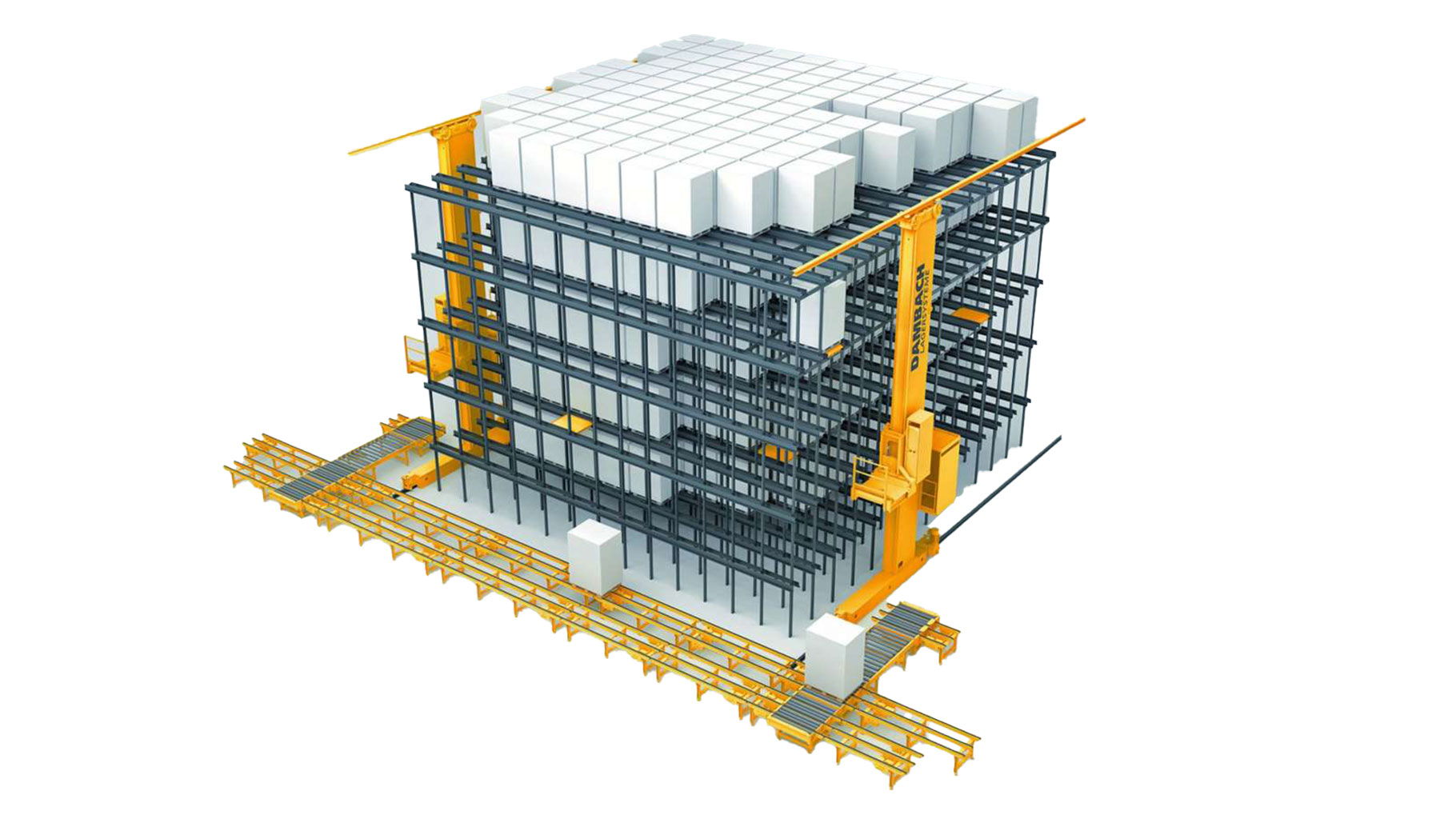
The shuttle technology uses autonomously moving shuttles to store and retrieve pallets within storage channels. The shuttles move horizontally on guide rails in the racks, while lifting devices or lifts take over the vertical transportation between the levels. This system enables particularly compact storage with high flexibility and is ideal for applications with high storage density and medium to high throughput. Compared to classic storage and retrieval machines, shuttle technology offers faster access times and greater dynamics. It is particularly suitable for companies with many article movements, varying pallet types or limited building volumes. Shuttle warehouses can also be modularly expanded and easily integrated into existing IT and conveyor systems.
An automated pallet warehouse with automated guided vehicles (AGVs) relies on autonomous vehicles to transport pallets between storage locations, production areas and transfer points. The AGVs navigate through the warehouse using sensors, lasers or QR codes and take over the material flow without a fixed route or rail system. This solution offers a high degree of flexibility, as routes and destinations can be adapted via software control. AGV-based warehouse operation is particularly advantageous in dynamic environments with frequent layout changes or limited space. The warehouse itself is designed as a floor storage system, flat rack storage system or with partially automated storage and retrieval systems. AGVs can be easily integrated into existing systems such as conveyor technology or ERP/LVS and enable step-by-step automation. They are particularly suitable for medium-sized warehouses with varying material flows and high automation requirements.
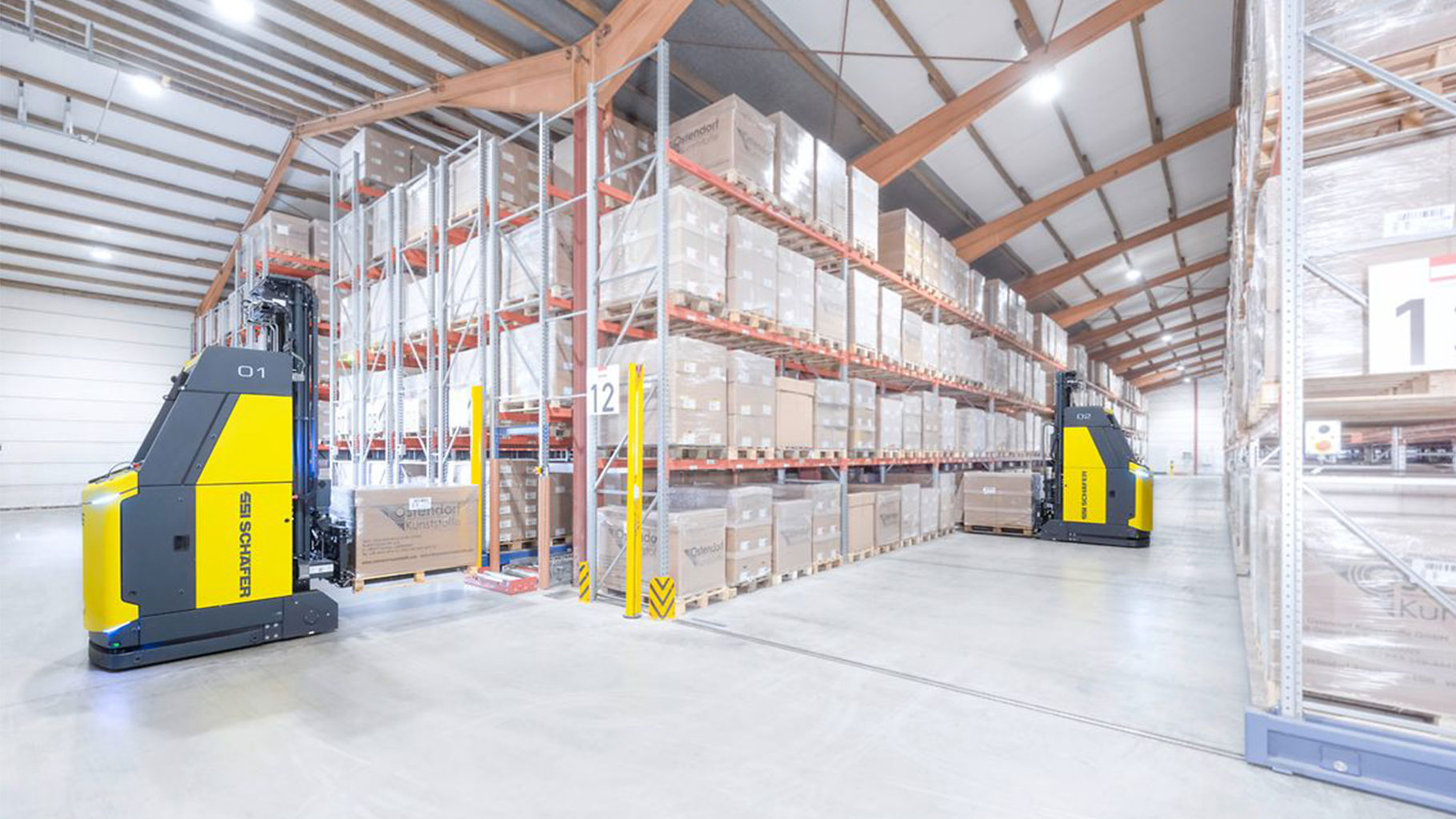
An automated pallet warehouse consists of several basic components that together enable an efficient, safe and fast storage system:
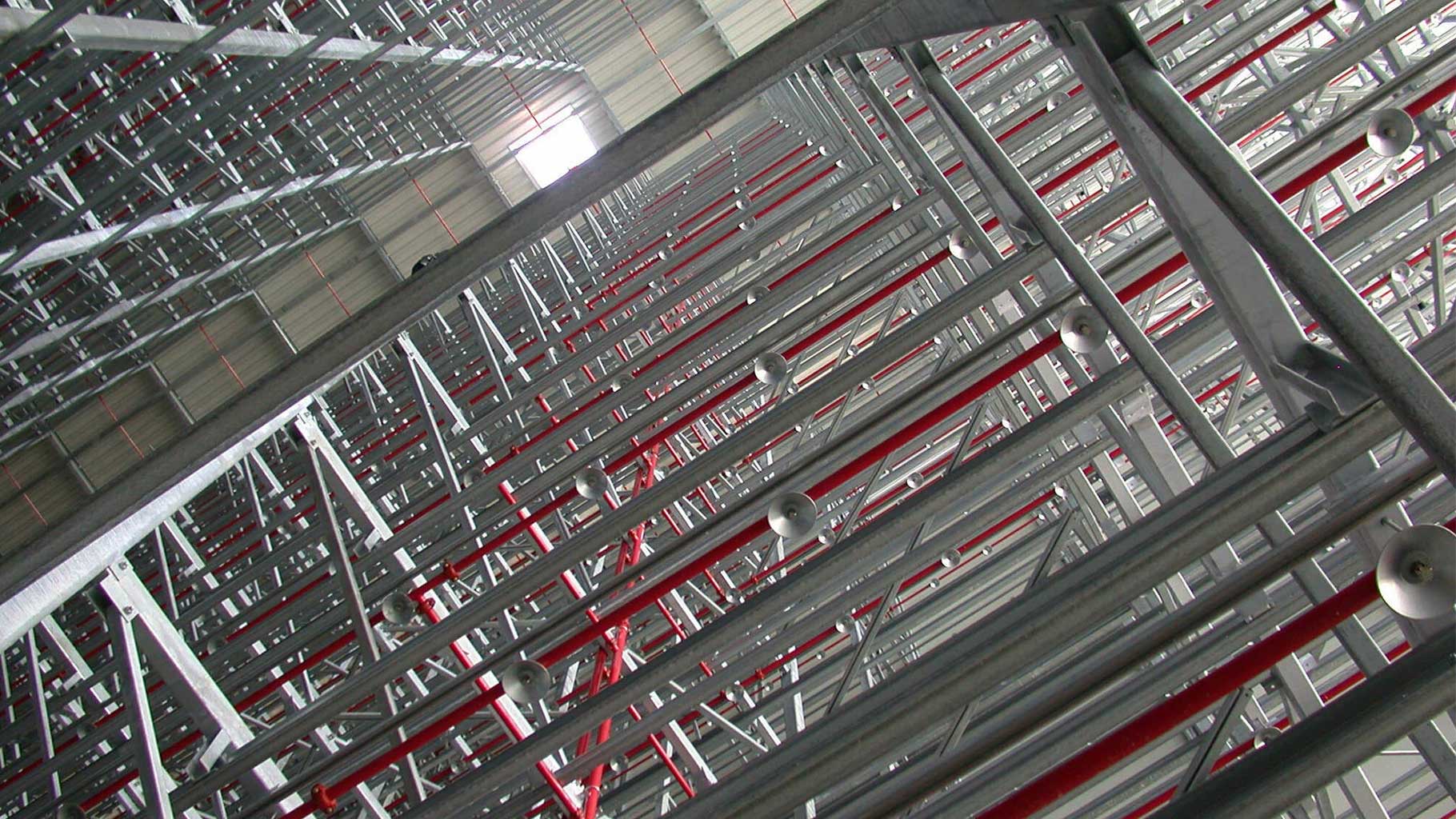
Rack construction: The central element, usually made of steel, provides storage space for pallets on several levels. The height can be up to 50 m. The racking must be adapted both to the stored goods and landing carriers as well as to the storage technology that removes and transports the materials.
Automated load handling systems: These systems are technical units that independently pick up, transport and deliver goods or load carriers such as pallets. They not only ensure an efficient, low-error material flow, but also enable precise, automated storage and picking. Examples include storage and retrieval machines, shuttle systems and automated guided vehicles (AGVs). Stacker cranes perform both vertical and horizontal movements. Within shuttle systems, however, the shuttle only performs the horizontal movements, while pallet lifts perform the vertical movements. AGVs can move freely to any position in the warehouse and set them down at any height in the racking.
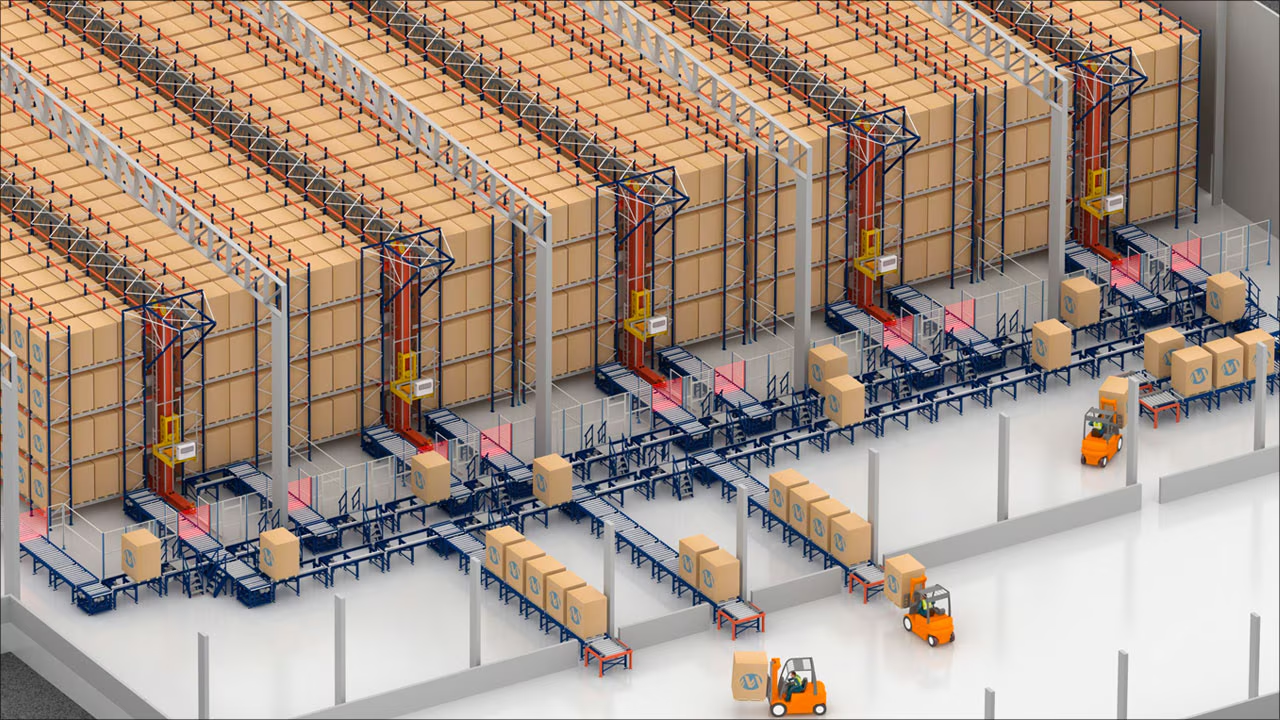
Conveyor technology: All the technologies shown should be sensibly connected to downstream conveyor technology. The decisive factor here is always the overall efficiency of end-to-end processes. Consequently, the performance and general conditions of the stored goods must be coordinated between the storage system and the conveyor technology.
Control and warehouse management software (WMS): An automated pallet warehouse is a complex system. The load handling systems have to be controlled as well as the conveyor technology. This is usually done with PLC control systems. Warehouse management software (WMS) with an interface to the ERP system is required to manage the storage locations, stocks, storage and retrieval operations and storage strategies.
Pallet identification: Barcode scanners or RFID systems automatically recognize pallets and ensure that they are stored correctly. The consistent identification of stored goods and the consistent scanning of storage units ensures that a clear assignment between storage location and storage unit is possible at all times.
An automated pallet storage system offers significantly greater efficiency and process reliability compared to manual warehouse operations. By using technologies such as storage and retrieval machines, shuttles or AGVs, storage and retrieval processes are carried out precisely, quickly and error-free. Automation enables optimum use of space, particularly in terms of height, which leads to a significantly higher storage density. At the same time, operating costs fall in the long term due to reduced personnel and error costs. Traceability and stock control are also improved, as all movements are digitally documented. In addition, occupational safety is increased as heavy and dangerous transportation processes are no longer carried out manually. Automated systems are particularly advantageous for high throughput, constant capacity utilization and 24/7 operation requirements.
Automated pallet storage systems are characterized by high performance and efficiency in the internal material flow. Modern storage and retrieval machines achieve storage and retrieval rates of up to 60 double cycles per hour, while shuttle systems in conjunction with lifts even enable up to 100 pallet movements per hour and aisle. This speed allows large quantities of goods to be moved reliably and without bottlenecks, even at peak times. However, the respective performance depends crucially on the design of the warehouse with regard to the height, depth, length and nature of the stored goods. The systems work around the clock with constant performance and reduce errors and downtimes to a minimum.
Automated pallet storage systems are generally designed for standardized pallet formats, but can also be adapted to special sizes. Euro pallets (1,200 × 800 mm) and industrial pallets (1,200 × 1,000 mm) are most commonly used, as they offer a high level of compatibility with storage and retrieval machines and conveyor systems. Many systems also support half pallets (800 × 600 mm) or Düsseldorfer pallets (600 × 400 mm), often via special carrier frames or add-ons. In addition, special formats up to around 1,600 × 1,200 mm can be processed, provided they are designed to be weight and stability-compatible. In addition to the floor space, the weight (usually up to 1,000-1,200 kg) and the ability to drive under the pallets are decisive for the system design. Modern storage technology can be configured flexibly so that mixed formats are also possible within a system. For maximum efficiency, however, standardization of the load carriers is recommended.
Fire protection in automated storage systems is a key aspect of system planning and must be considered at an early stage. Sprinkler systems are often used, either conventionally above the storage area or integrated into the racking system, to ensure rapid extinguishing in the event of a fire. Alternatively, or as a supplement, early fire detection systems such as smoke aspiration systems (RAS) or thermal sensors are installed, which sound the alarm even in the event of minimal smoke development. In closed or deep-frozen warehouses, gas extinguishing systems (e.g. with CO₂ or inert gas) are often used to protect sensitive technology from extinguishing water. In addition, fire protection separations, such as fire compartments, fire doors or fireproof enclosures, are common measures. The selection of a suitable solution depends on the type of warehouse, the fire load (e.g. plastic packaging) and the structural environment. All systems must be coordinated and clarified with the local fire department and insurance company in order to comply with the legal requirements and standards for sprinkler systems such as VdS 3891 or DIN EN 12845.

Manager, Hamburg
His focus is on production technology. His experience and knowledge include production management, factory planning, value stream mapping, lean management, intralogistics planning and change management.



Senior Manager, Munich
The industrial engineering graduate advises his clients on issues relating to warehouse and logistics planning and the digitalization of logistics (particularly in the ERP, WMS and TMS environment). He also provides clients with comprehensive support in the areas of operations management and strategy.
Product Mining is a new, data-driven platform technology to make complexity management in manufacturing companies…
Reduce costs, increase efficiency, ensure quality - this article shows you in a practical way…
Automated guided vehicles (AGVs) have been on the market for many years. Many companies now…
You need to load content from reCAPTCHA to submit the form. Please note that doing so will share data with third-party providers.
More InformationYou are currently viewing a placeholder content from Turnstile. To access the actual content, click the button below. Please note that doing so will share data with third-party providers.
More InformationYou are currently viewing a placeholder content from Facebook. To access the actual content, click the button below. Please note that doing so will share data with third-party providers.
More InformationYou are currently viewing a placeholder content from Instagram. To access the actual content, click the button below. Please note that doing so will share data with third-party providers.
More Information