Logistics
Optimize logistics processes
More transparency and efficiency in your logistics processes
The requirements for your future logistics processes are diverse and affect all areas of the value chain. When processes in procurement, incoming goods, warehousing, production line supply and distribution are optimally coordinated, valuable synergies are created along the entire end-to-end process chain. Efficient workflows in inbound, intralogistics and outbound processes not only increase performance, but also reduce interface problems and create sustainable cost benefits. With a holistic approach, we analyse your logistics processes, identify optimization potential and develop individual solutions ranging from warehouse logistics and material flow to specialized requirements such as hazardous goods, refrigeration or recyclables logistics.

Process recording
Maximum transparency in your end-to-end logistics processes
Logistics processes extend into all areas of the company and therefore play a central role in your company’s success. Do you have an overview of your current process landscape? And do you know exactly how your inbound, intralogistics or outbound processes work? As part of our logistics process management, we therefore analyze your current processes and work with you to develop a tailor-made concept for the future.
Using comprehensive and specific basic analyses from our toolbox, we identify your fields of action. During process mapping, we systematically record all relevant processes along your value chain. We analyze your process data such as production orders or incoming goods data, carry out a material flow analysis and record your on-site processes. In doing so, we always focus on an end-to-end approach. In order to record individual process steps in sufficient detail, we involve relevant specialist departments and responsible persons.
Our service packages:
- Analyze the current status of your entire process chain
- Evaluate process data such as production orders
- Systematically analyze and present material flows
- Involve relevant departments and people
- Developing a future concept for your process landscape
Your benefit:
- Transparent overall view of your end-to-end process landscape
- Reliable basis for decision-making thanks to validated as-is analysis
- Early identification of specific optimization potential
- Clear basis for targeted measures and process improvements

Philipp Carl
Senior Manager Logistics
Talk to me!
Would you like to optimize or redesign your logistics processes? Send me your message and I will get back to you as soon as possible.
Inbound planning
Designing optimal logistics processes in procurement
Procurement logistics ensures that the materials for your production are available in sufficient quantities and that you remain capable of acting. Efficient and target-oriented procurement logistics ensures a high level of supply readiness and keeps your costs as low as possible – thus enabling you to reduce your capital commitment.
We support the efficient planning of processes within procurement logistics. To do this, we analyze your delivery flows and your delivery structure and identify bottlenecks. In this context, we clarify questions such as whether you can distribute your deliveries over a certain period of time, whether deliveries with certain materials can be combined or how your buffer area should be dimensioned. As part of yard planning, we create an efficient and target-oriented traffic and material flow – from access to unloading the goods at the optimum unloading point.
Our service packages:
- Analyze deliveries and delivery flows
- Create yard and traffic flow planning along the entire supply chain
- Correctly dimensioning the buffer tank
- Check timing of deliveries to avoid bottlenecks
Your benefit:
- High supply readiness with low capital commitment
- Fewer bottlenecks in the availability of your raw materials
- More efficient use of yard and storage space
- Improved planning and controllability of delivery processes
Intralogistics planning
Benefit from synergy effects with all adjacent areas.
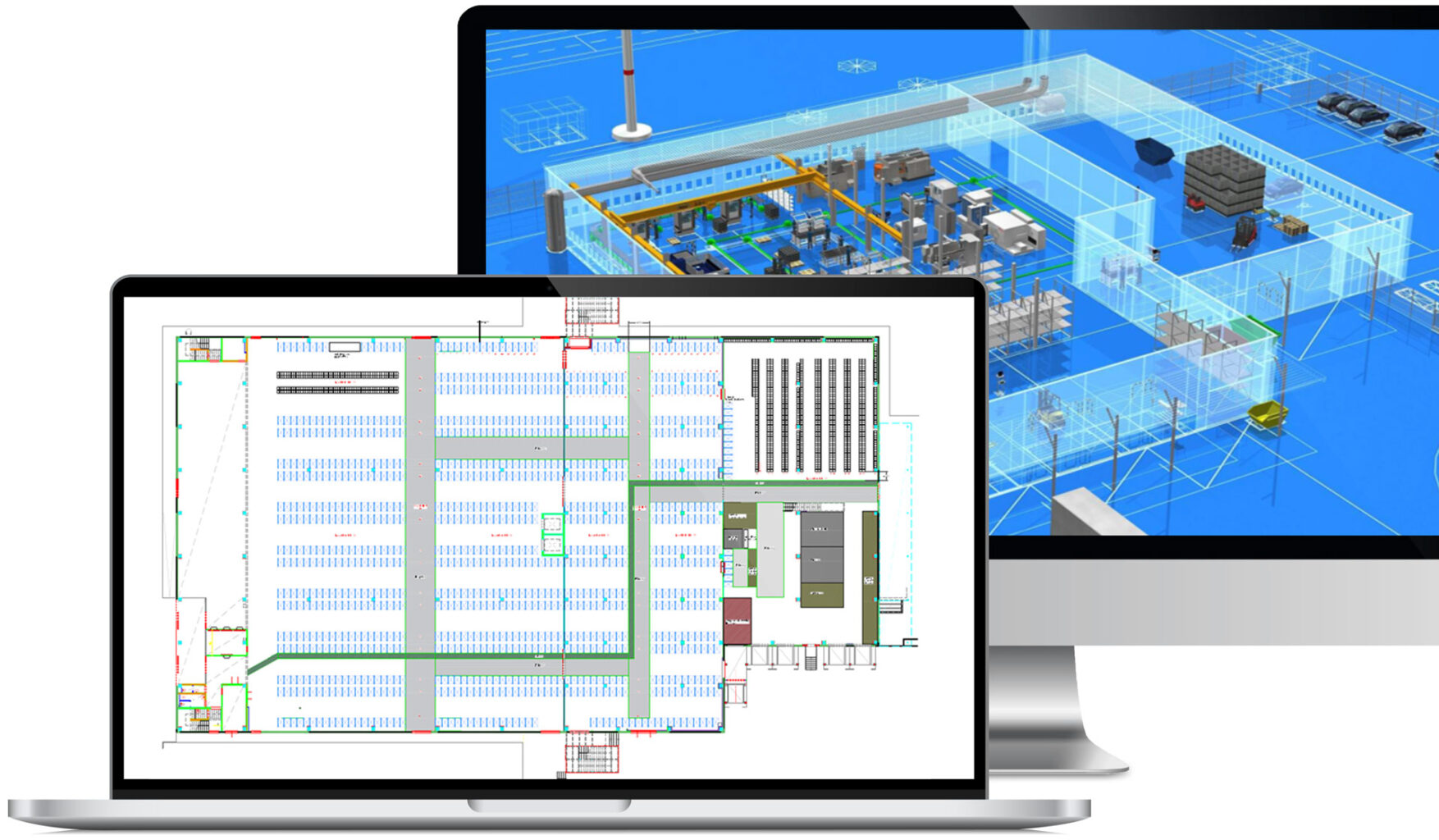
Without structured, defined and target-oriented processes, the individual areas of intralogistics cannot be linked. This results in supply bottlenecks, high stock levels and low material availability. In extreme cases, orders cannot be fulfilled as a result.
To overcome these challenges, we identify weak points and potential in your processes in our intralogistics process analysis. Based on your future requirements, we develop intelligent and efficient logistics processes from goods receipt, storage and picking through to goods issue. Our intralogistics planning ensures that all steps are optimally coordinated.
Incoming goods
In incoming goods, for example, we plan your unloading processes and optimally integrate quality assurance – either automatically or manually – into your material flow. We also analyze your deliveries and determine the economically optimal number of workers.
Storage and retrieval of your raw materials and finished goods
A central component of intralogistics is the warehouse and the associated storage and retrieval process. We make sure that your goods are stored in your designated storage location. For example, we use your order structure and performance data to analyze optimal storage (e.g. FiFo, LiFo, ABC structuring). In addition, we work with you to create the basis for the connection to your IT infrastructure. Sophisticated intralogistics planning helps to use resources efficiently and reduce storage costs.
Picking and consolidation
Picking takes over the provision of goods from your warehouse. We work with you to determine the optimum picking method for your value chain: Is the “goods-to-man” or “man-to-goods” picking method more suitable for you? Should your goods be picked centrally or decentrally? And can orders be put together? We also analyze your data and processes in order to identify possible Kanban materials, for example.
Line supply and disposal
We also examine how you can optimally integrate your production lines into your process chain: What should the optimum level of automation look like? Are driverless transport systems worthwhile for your line supply or disposal? Which new and innovative solutions are suitable for your company? Can you centralize or decentralize your packaging processes?
Outgoing goods
As incoming goods has many interfaces with other areas of the company, it plays a role in securing the company’s existence and substance. It is therefore essential to continuously optimize and standardize it. We optimally integrate your outgoing goods into the value chain and create synergies between intralogistics and distribution logistics. In addition, we analyze your processes and order compositions together, plan the loading processes, dimension your pre-picking and buffer areas and integrate value-adding yard management.
Our service packages:
- Identify and exploit optimization potential in all areas of intralogistics
- Design the required areas and bearings for quality assurance (e.g. spear bearings or measuring equipment bearings)
- Examine and optimize inventory management, empties management and returns processing
- Define storage and retrieval strategies and picking processes
- Systematically analyze order composition and material flows
- Determine the optimum degree of automation (e.g. driverless transport systems)
Your benefit:
- Increased delivery capability thanks to stable and coordinated intralogistics processes
- Avoidance of bottlenecks along the entire material flow chain
- Improved, efficient storage and retrieval process
- Reduced storage and throughput times
- Efficient and value-adding order picking
- Better connection to incoming goods and production supply
- More process reliability through automated solutions
- Reduction of inventories and greater transparency in the material flow
Outbound planning
Increase the performance of your distribution.
The aim of distribution logistics is to ensure that the right product reaches the customer at the right time, in the right place, in the right quality and quantity and at the right cost. Efficient and target-oriented procurement logistics make it possible to increase product availability, reduce your logistics costs and increase your service level, among other things.
We are happy to support you in profitably optimizing your distribution logistics. To do this, we analyze your route planning as well as your order structure and composition and uncover bottlenecks. For example, we examine whether orders can be compiled according to characteristics such as country, region or retailer. Within yard planning, we optimize the processes on your premises. In this way, we create an efficient and target-oriented flow of traffic and materials: from accessing and unloading the goods at the optimum loading point to leaving your premises.
Our service packages:
- Analyze and optimize your route planning and order structure
- Check and optimize order composition by region, country or dealer
- Uncovering bottlenecks and potential
- Improve traffic and material flow within yard planning
Your benefit:
- Improved product availability and delivery capability
- Lower logistics costs thanks to more efficient distribution processes
- Increase the level of service to your customers
- More process reliability throughout outgoing goods
- Better controllability of tours and shipping processes
Special logistics solutions
Implement industry-specific requirements along your process chain.
Do you have very specific logistics requirements for the processes along your value chain? For example, do your processes have to be designed in accordance with certain regulations or standards? We will work with you to find the right solution that meets both the state of the art and current regulations and standards. With us, you gain a partner who will respond to your individual requirements in order to optimize your logistics processes in the best possible way.
In the electrical engineering sector, for example, we develop specific disposal concepts that take sustainability aspects into account. This industry can also benefit from our expertise in securing the ESD chain and customs clearance, for example.
Or we address the special requirements of hazardous goods logistics, chemicals and pharmaceuticals. For companies in this sector, it is particularly important that relevant safety regulations are observed, special containers are used and staff are adequately qualified. We are also in tune with the times when it comes to refrigeration logistics: we find the regulations that are relevant to your processes among the various sets of rules, GMP/GDP, HACCP or VDI guidelines and create solutions tailored to them.
Our service packages:
- Developing tailor-made solutions for special logistics requirements
- Incorporate current rules, standards and regulations
- Analyze and optimize processes with regard to the relevant standards
Your benefit:
- Improved transparency of your industry-specific processes
- High process reliability along your process chain
- Ensuring logistics processes comply with standards and regulations
- Increased process quality and compliance

Top 5 methods for process optimization
Efficient logistics processes are not created by chance, but rather are the result of a structured analysis, clearly defined objectives and proven methods. In order to create transparency, shorten throughput times and sustainably reduce costs, we rely on a methodical toolbox in logistics process management. In addition, we combine these methods according to the objectives, data availability and maturity level of your organization.
1. process mining – data-based transparency of your logistics processes
Process Mining enables an objective, fact-based analysis of your logistics processes based on real process data from ERP, WMS or TMS systems. Instead of using assumptions or workshops alone, your actual process flows are visualized – including variants, loops, waiting times and media breaks. This allows us to identify bottlenecks, deviations from the target process and hidden inefficiencies along your end-to-end logistics processes.
2. material flow analysis – understanding routes, quantities and dependencies
The material flow analysis creates transparency about movements, quantity flows and interfaces in your inbound, intralogistics and outbound structure. We systematically record and evaluate transports, warehouse movements and buffer points so that unnecessary routes, duplication of work and capacity bottlenecks become visible and create the basis for efficient layout and process design.
3. value stream mapping – holistic view of your logistics processes
With value stream mapping, we look at your logistics processes from an end-to-end perspective and consistently differentiate between value-adding and non-value-adding activities. The aim is to reduce throughput times, lower inventories and optimally coordinate information and material flows – from procurement to distribution.
4. simulation and scenario analysis – well-founded decisions instead of gut feeling
With the help of logistics simulations, we test future process variants, layouts or volume scenarios before they are actually implemented. Whether increasing production volumes, changing order structures or new automation solutions – simulations create planning security and significantly reduce investment risks.
5 KPI and key figure systems – controlling your logistics performance
A consistent KPI system is essential for the sustainable management and continuous improvement of logistics processes. We work with you to define relevant logistics KPIs – such as throughput times, inventories, service level or process costs – and anchor these in a transparent management model.
Our service packages:
- Select and combine suitable methods for process optimization
- Perform process mining analyses on the basis of system data
- Create material flow and value stream analyses along the process chain
- Develop and evaluate future scenarios using simulation
- Set up KPI and control systems for your logistics
Your benefit:
- Objective transparency about your actual logistics processes
- Identification of bottlenecks, inefficiencies and cost drivers
- Reduction of throughput times, inventories and process costs
- Sound decision-making basis for investments and automation
- Sustainable optimization of your end-to-end logistics processes
FAQ
How can inbound processes in logistics be optimized?
Inbound processes can be optimized by conducting a comprehensive analysis of incoming shipments, material flows, and yard operations. Key measures include scheduling deliveries, optimizing unloading processes, sizing buffer areas to meet demand, and reducing bottlenecks in goods receiving. As a result, companies improve material availability, reduce inventory, and increase supply reliability.
How can companies make their outbound processes more efficient?
Efficient outbound processes result from optimizing order picking, route planning, and shipping processes. In addition, intelligent yard planning, optimized loading processes, and the coordination of outbound shipping and distribution help to shorten lead times, reduce transportation costs, and improve service levels for customers.
What methods are suitable for optimizing logistics processes?
Five methods in particular have proven effective for optimizing logistics processes:
– Process mining for analyzing real-world process flows based on system data.
– Material flow analysis for optimizing transportation, warehouse movements, and material flows.
– Value stream mapping for identifying non-value-adding activities.
– Simulations and scenario analyses to evaluate future process and layout variants.
– KPI and key metric systems to measure and sustainably manage logistics performance.
Which method offers the greatest benefit depends on the company’s goals, data availability, and the specific potential for optimization.