Production
Production strategy
Production strategy: the key to efficiency and competitiveness
Successful production is the result of a clear strategy. In an increasingly dynamic environment, the correct alignment of your production determines how flexible, efficient and competitive your company remains in the long term. We support you in aligning your production with the requirements of the market, customers and corporate strategy. Together, we identify the most important potential and develop a customized production strategy for efficient and future-proof production. This creates the basis for measurable improvements along your value chain and sustainable corporate success.


Philipp Kappus
Senior Production Manager
Feel free to contact me!
Would you like to tailor your production strategy to best meet your goals? If so, please feel free to send me a message. I’ll get back to you right away.
As-is analysis
Transparency regarding the current competitive situation, product portfolio and customer requirements
In the first step of our production consulting, we analyze both the company’s internal status quo and the business environment. Experience has shown that the corporate and marketing strategy play a central role here, as they form the basis for the direction of all corporate activities. They define the long-term goals and priorities and show why certain measures and decisions need to be taken. They therefore set the direction and help to bring production and the product portfolio in line with the overarching objectives.
The subsequent segmentation of the products helps to gain a clear overview of the product portfolio and to differentiate between customer requirements. While costs are often the decisive criterion for commodity products, other differentiation factors such as a convincing service or a wide range of configurations are usually decisive for premium and customer-specific products. We also look at the prevailing principles of make-to-stock (MTS), make-to-order (MTO) and engineer-to-order (ETO) in order to assess the impact on the production strategy.
The as-is analysis is also based on a comprehensive examination of your current competitive and market situation. This makes it possible to identify existing trends and developments that are crucial for strategic alignment.
The results of this phase are summarized in the form of a clearly structured overview that shows strengths, weaknesses, opportunities and risks. This summary forms the basis for deriving the strategic direction of production in the next step.
Our Service Packages:
- Analyze corporate and marketing strategy and derive production requirements
- Structure product portfolio and evaluate customer requirements
- Identification of customer requirements per product family (incl. MTS, MTO and ETO)
- Carry out competition and market analyses
- Integrating stakeholder perspectives
- Creating a SWOT analysis as the basis for strategy development
Benefits for you:
- External view of the company’s strategic direction
- Alignment between customer, marketing and production perspectives
- Common understanding of all relevant stakeholders
Goal definition
Definition of strategic guidelines for your production
After analyzing the current situation, there is a wealth of information that now needs to be translated into concrete production goals. First of all, the overarching question of how you want to differentiate yourself on the market must be clarified. For example, through cost or quality leadership? By providing customized production or exceptional service? There are often two or three dominant differentiation factors that form the basis of your production strategy.
In addition to the differentiation factors, there are often targets for conquering new markets, occupying niche markets and expanding the product and service portfolio, among other things. The goals set in this phase are defined SMART together with all relevant stakeholders for a period of 3 to 5 years. The result is the Rothbaum strategy compass, which clearly and bindingly describes the strategic direction of production for the coming years.
Our Service Packages:
- Define overarching differentiation strategy (e.g. costs, quality)
- Define corporate strategy in SMART goals for production
- Define key figures for each target area, e.g. OEE, capacity utilization, reject rate
- Bundling strategic goals according to the Rothbaum Strategy Compass
Benefits for you:
- Production and corporate strategy go hand in hand
- Anchoring production as a central component of the company’s success
- Target-oriented management of production
- Measurability and traceability of successes
Key decisions and levers
Determining the key points for the future production strategy
Once the production targets have been clearly defined, the question arises as to how they can be implemented in concrete terms. We differentiate between seven central production levers to ensure that the previously defined goals are met.
- Operations footprint (locations, size, specialization, layout, logistics concept)
- Vertical integration(make-or-buy, supplier selection, supply chain management)
- Process technology (vertical integration, production technology, production processes, equipment, degree of automation)
- Production planning and control (production program, capacity planning, sales and operations planning, warehouse planning, order processing)
- Organization & employees (organizational structure, bonus system, employee development)
- Operational excellence (lean tools, just-in-time principles, improvement programs, performance systems & KPIs)
- IT architecture (MES system, ERP integration, cybersecurity, performance monitoring)
An elaborate improvement program could potentially be derived from each production lever, but this is often associated with a high consumption of resources. Instead, our aim in strategy work is to make the key decisions for the next 3 to 5 years, develop a clear vision for the future and shape the target image of production holistically and sustainably for the coming years.
Our Service Packages:
- Evaluate production levers by comparing them with industry standards
- Develop a 3-5 year target picture for each lever
- Identify quick wins and immediate measures
- Carry out a cost-benefit analysis of medium and long-term planned measures
Benefits for you:
- Transparency about outdated and inefficient processes
- Realistic target achievement through concrete levers
- Proven best-practice experience from the Rothbaum partner network
- Holistic view of all relevant fields of action
Implementation and monitoring
Ensuring gradual and sustainable implementation
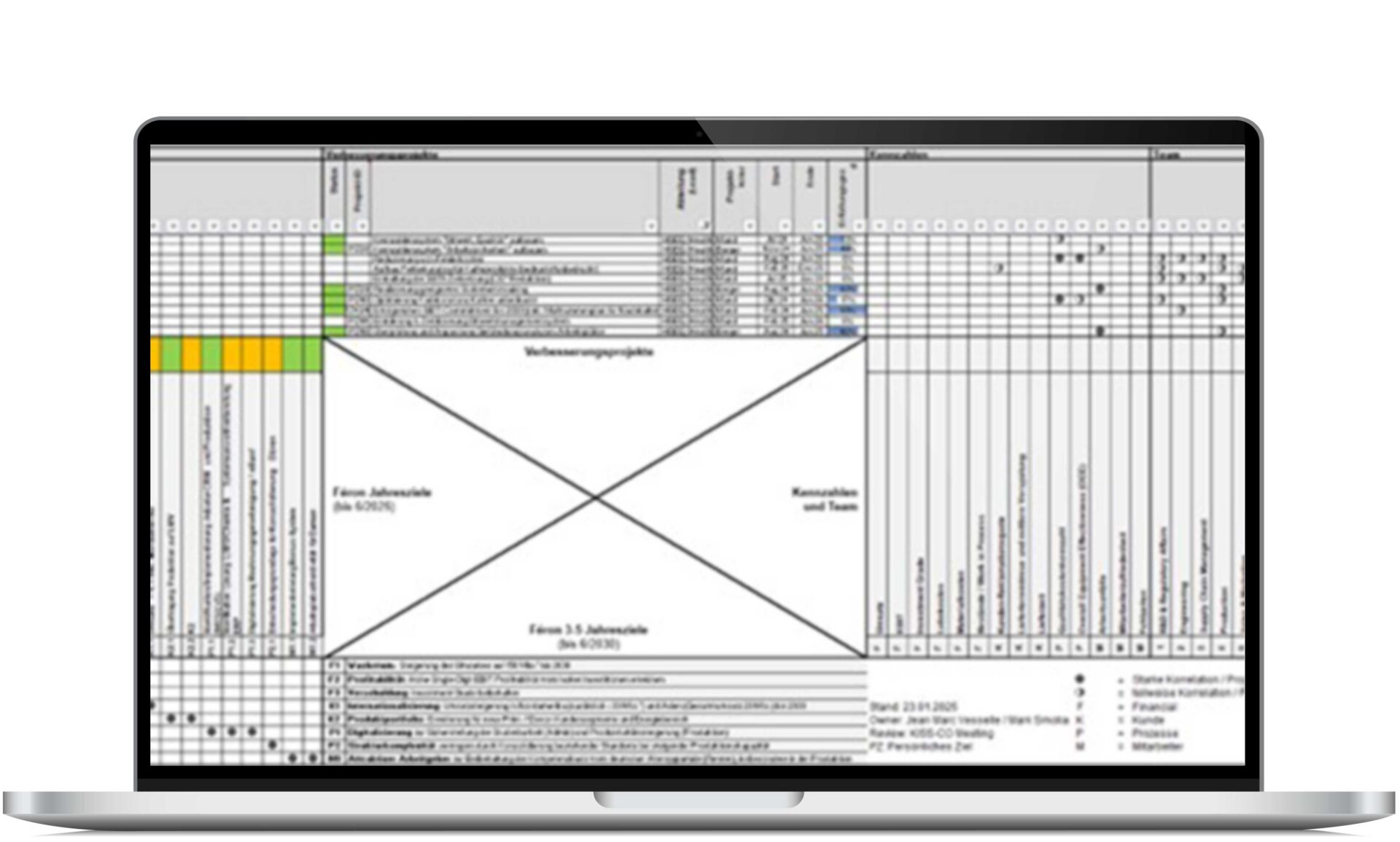
The immediate measures and medium and long-term strategies identified in the previous phase cannot usually be implemented as part of day-to-day business alone. It is therefore necessary to define improvement projects that specify the timeline, responsibilities, key milestones and potential risks. These projects are integrated into a roadmap that enables clear prioritization.
We use an operating model to implement the strategy holistically and maintain an overall view. We rely on methods such as Objectives and Key Results (OKR), Management by Objectives (MbO) or Hoshin Kanri. For example, the strength of the Hoshin Kanri method developed in Japan is the alignment of the operational activities of all employees with the objectives of production. The X-matrix (see image) serves as a visual tool to link strategic objectives, key projects and key performance indicators with each other and to monitor the degree of fulfillment on a recurring basis.
Our Service Packages:
- Define improvement projects and prioritize them in a roadmap
- Establish an operating model (e.g. Hoshin Kanri) to control the software-based implementation
- Anchoring strategy implementation in regular communication and management processes
- Visualize production strategy for the store floor
Benefits for you:
- Consistent implementation of the production strategy in the entire operations area
- Definition of responsibilities and resource planning
- Generate acceptance and alignment by operationalizing the goals
FAQ
How does Rothbaum Consulting help develop a production strategy?
Rothbaum Consulting works with companies to develop a customized production strategy that is consistently aligned with the company’s goals. To this end, we evaluate key levers such as the production network, make-or-buy strategy, production planning, automation, organizational structure, and IT landscape. Based on best practices and a structured analysis, we develop concrete measures that enable short-term improvements while simultaneously establishing a robust strategic direction for the coming years.
How can a production strategy be successfully implemented?
The success of a production strategy depends on consistent implementation. To achieve this, strategic goals are translated into specific projects, responsibilities, and key performance indicators and prioritized in a roadmap. Using established methods such as Hoshin Kanri, OKR, or Management by Objectives, progress can be monitored transparently and adjustments made early on. This ensures that the production strategy is permanently embedded in day-to-day operations and that sustainable improvements are achieved.