Production optimization: improve delivery reliability
In our blog series on production optimization, we present practical strategies for shortening throughput times…
BLOG series Automated storage systems
In this article in the blog series on automated storage systems, we look at narrow-aisle warehouses with automated guided vehicles (AGVs) within automated pallet warehouses as an efficient alternative to traditional high-bay warehouses with stacker cranes or shuttle systems. What are the advantages and what special requirements need to be considered? You can find the answer to this question and many other informative details in this article.
When it comes to an automated pallet warehouse, many people primarily think of a high-bay warehouse with storage and retrieval machines or a shuttle warehouse. However, an automated narrow-aisle warehouse is an efficient alternative. A narrow-aisle warehouse with an automated guided vehicle (AGV) is particularly space-saving, as it uses very narrow aisles and increases the storage density. The AGVs transport goods autonomously, can be used flexibly and can be easily integrated into existing systems. In comparison, automated storage systems with storage and retrieval machines (SRMs) or shuttles offer significantly higher storage and retrieval speeds, but are usually less flexible and require greater investment in infrastructure. AGVs are also often more scalable and are suitable for more dynamic warehouse environments. Overall, the choice of system depends heavily on the requirements for flexibility, speed and space utilization. We will show you what is important to consider.

Senior Manager Logistics
Are you looking for a suitable automated storage system and need support? Send me your message and I will get back to you as soon as possible.
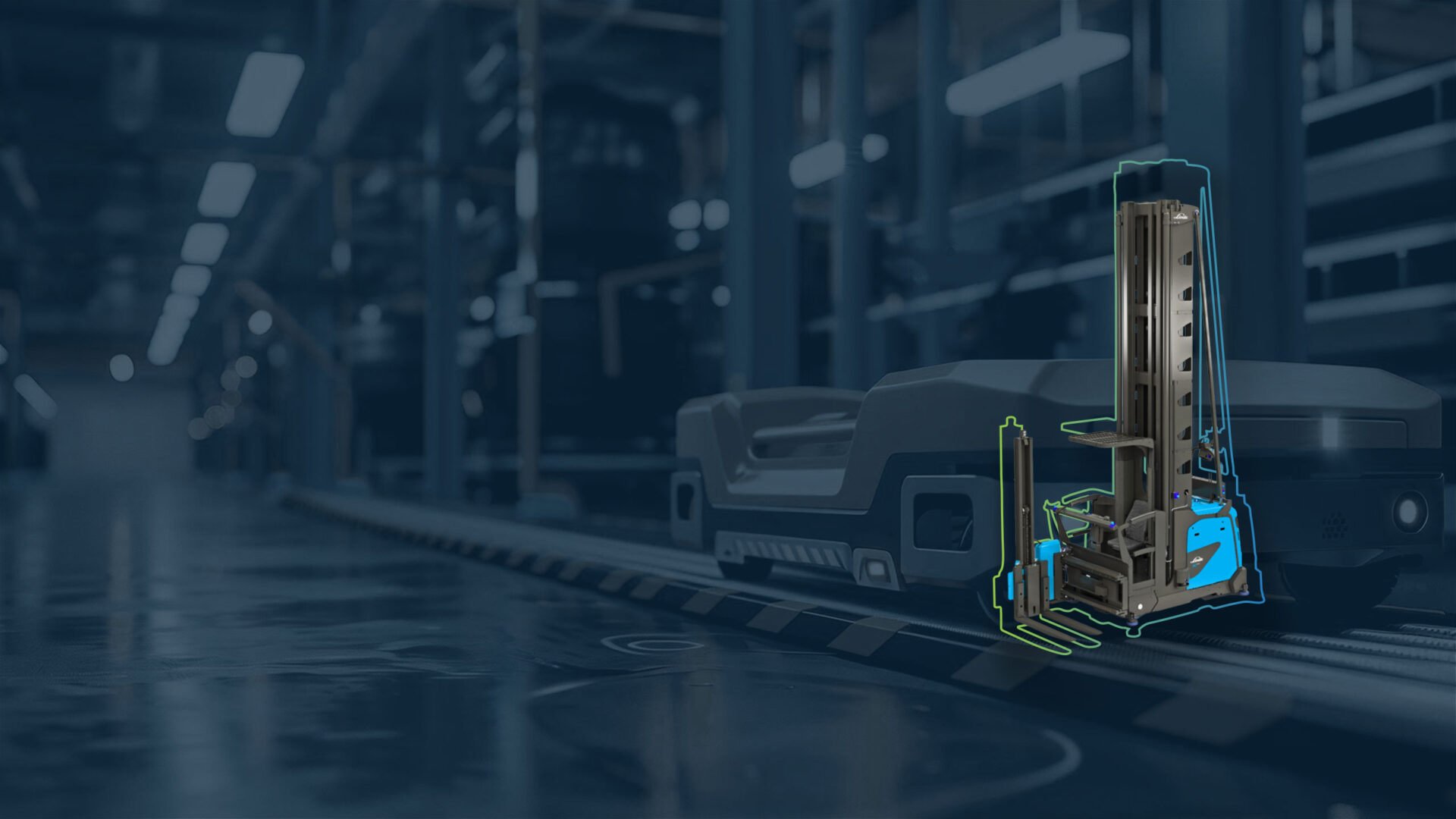
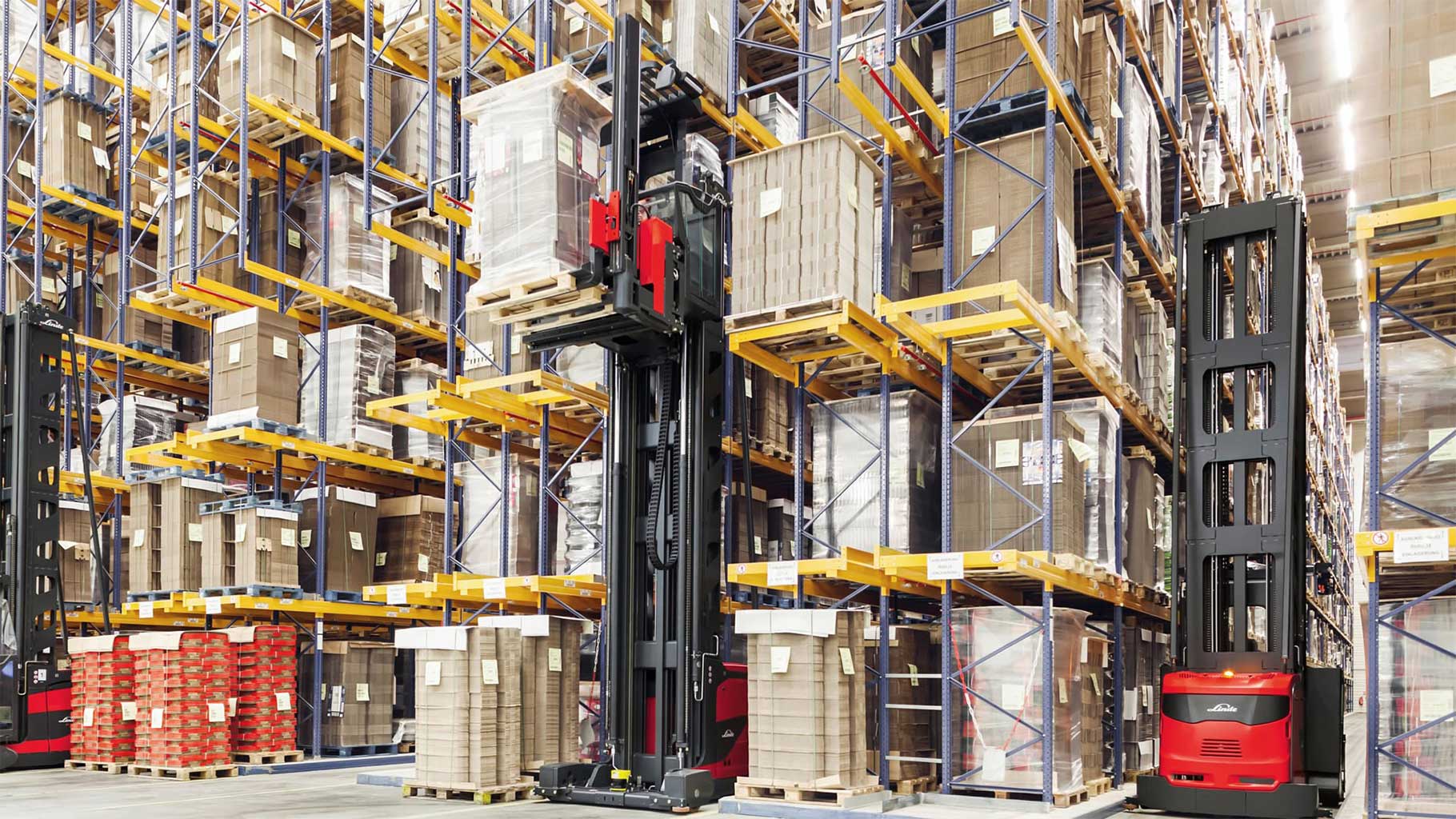
Within a narrow-aisle warehouse with an automated guided vehicle (AGV), rows of racks with very narrow aisles are arranged to save as much space as possible. The racks reach up to great heights in order to maximize storage density. AGVs move between the rows of racks, autonomously picking up and transporting stored goods. The vehicles are equipped with sensors and navigation technology to drive safely through the narrow aisles. Loading and unloading stations are usually located at the edge of the warehouse or at central transfer points. The entire system is controlled by a warehouse management system (WMS), which coordinates orders and efficiently allocates the AGVs.
The most important elements of a narrow-aisle warehouse with AGVs are as follows:
Narrow aisles: Minimized aisle widths enable optimum use of space. While aisle widths of 3.60 m are required for a front loader, narrow aisle stackers can reduce the aisle width to 1.80 m.
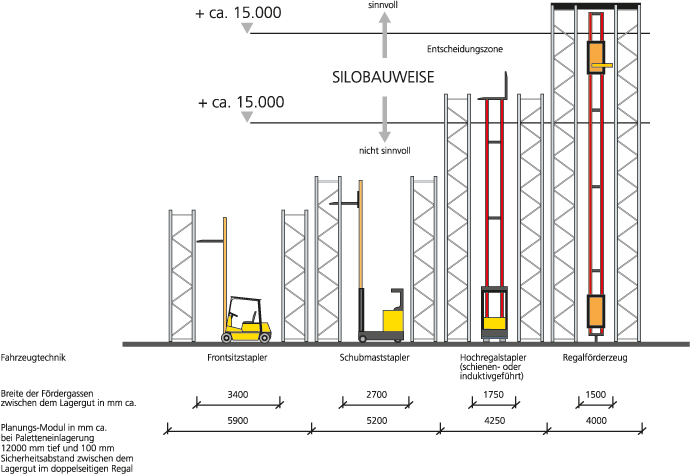
High-bay racking: Vertical storage increases storage capacity. The height of the racking is based on the clear room height and the maximum lifting height of the forklift, in this case the AGV.
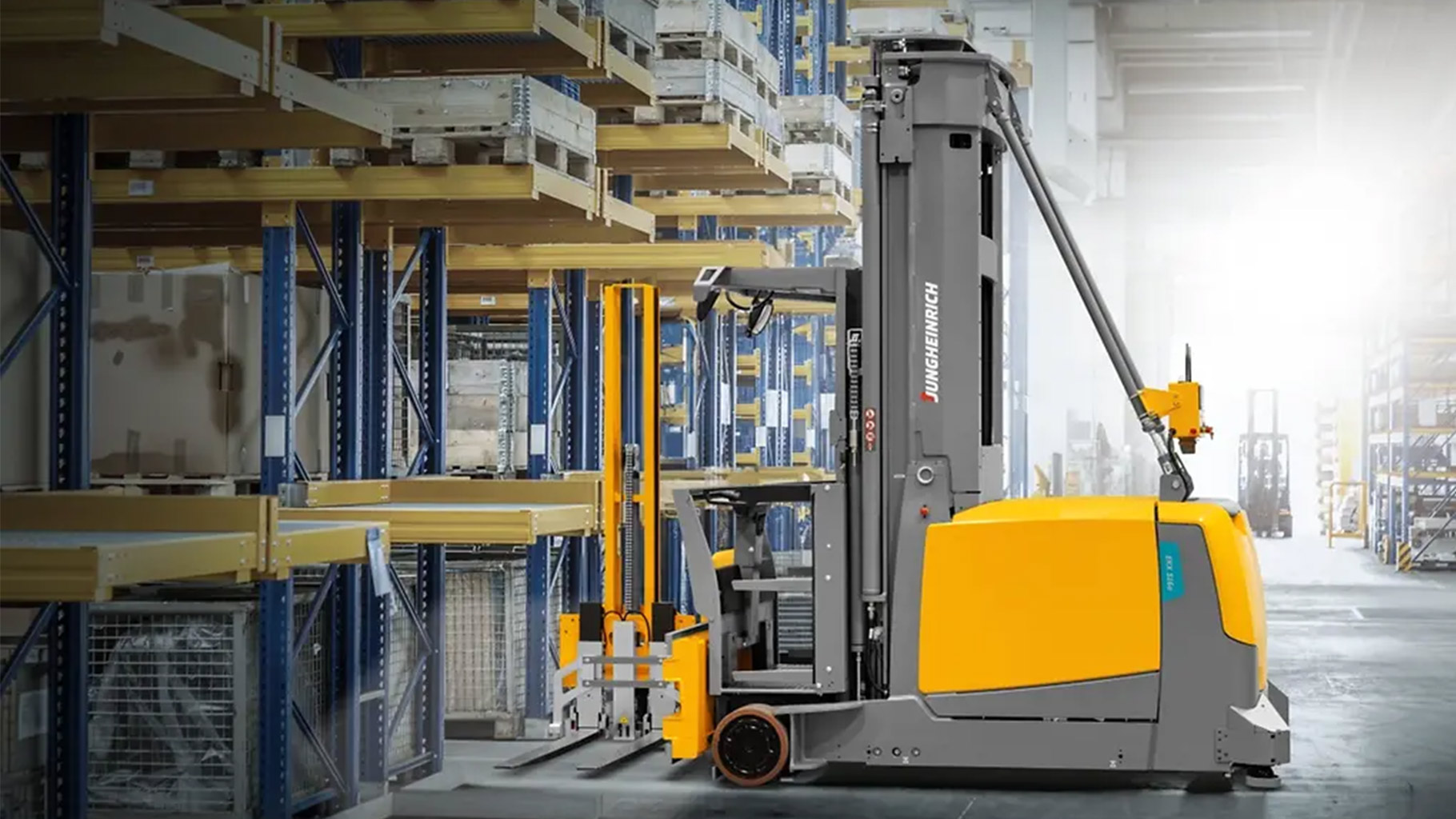
Automated guided vehicles (AGVs): Autonomous vehicles take over material transportation. The maximum lifting height can be up to 18 m, depending on the load capacity and dimensions of the stored goods. However, the speed is significantly lower compared to regular front loaders.
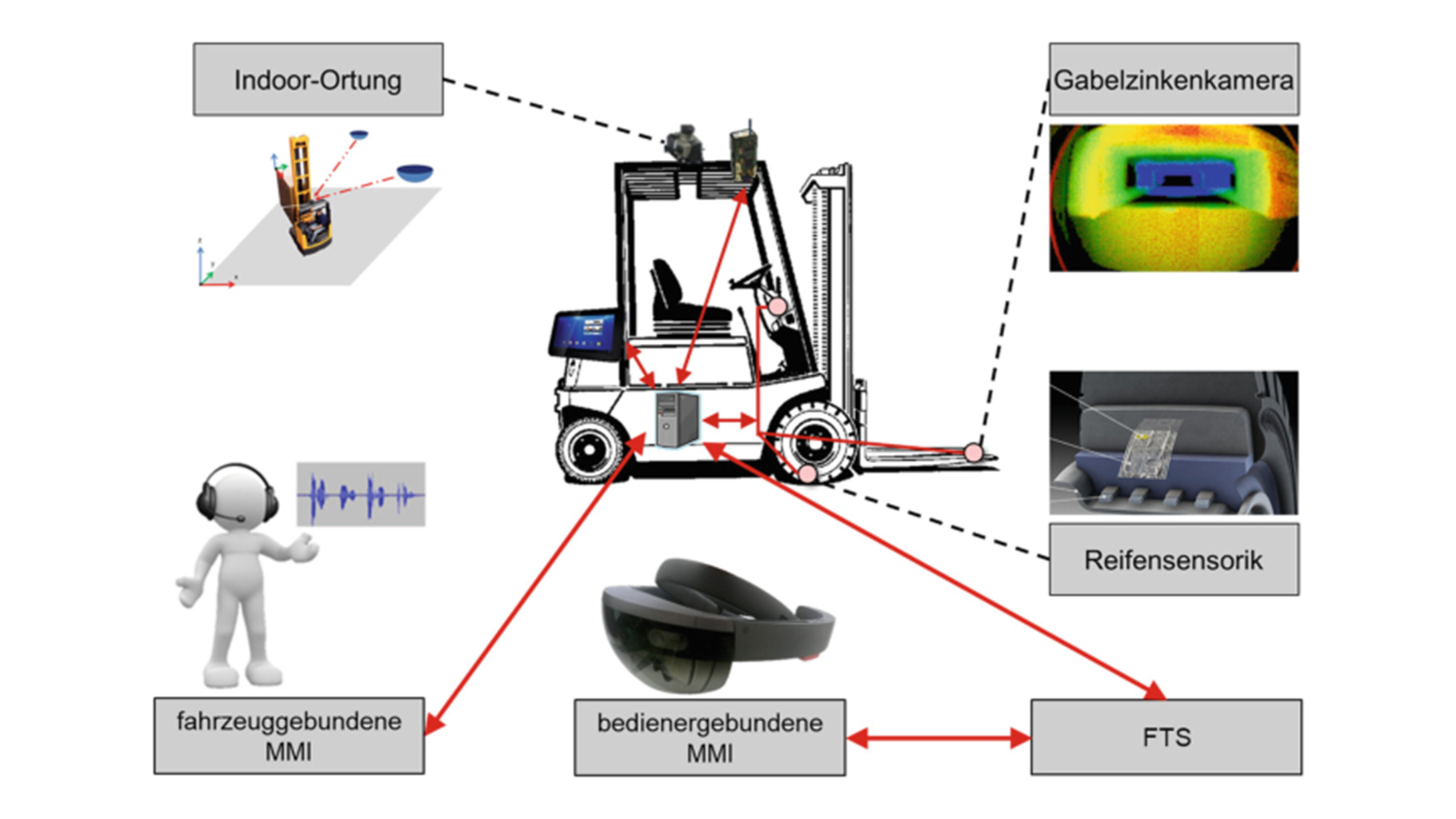
Navigation and sensor systems: The AGVs move safely and precisely, even in narrow aisles. Sensors and navigation systems not only cover the truck’s travel paths. Systems such as cameras or various sensors also help to avoid any collisions when setting down the pallets.
Transfer zone: Due to their low travel speed, narrow-aisle trucks are generally not used for transporting materials beyond the area of the narrow-aisle warehouse. Transfer zones should therefore always be planned. Here, the narrow-aisle forklift truck places the goods from the warehouse and transports stored goods into the narrow-aisle warehouse.
Warehouse management system (WMS): As with all larger warehouse systems, a centralized WMS with an interface to the ERP is important for coordinating and controlling both stocks and goods movements.
Narrow-aisle warehouses with AGVs offer a number of specific advantages over other automated storage systems. By using AGVs, the investment in a fixed infrastructure is significantly lower than with RGB or shuttle warehouses. Personnel costs are also minimized due to the autonomous transport of goods, which largely eliminates human error. The vehicles are equipped with modern sensors, which also increases operational safety. Another advantage is the continuous 24/7 operation without breaks, which significantly increases productivity. The system performance can be flexibly adapted by integrating additional AGVs into the system as required. In addition, the modular structure enables simple expansion and seamless integration into existing warehouse environments.
Compared to wide-aisle warehouses, narrow-aisle warehouses offer significantly greater space efficiency, as the aisles are reduced to a minimum. This means that significantly more storage capacity can be created in the same space. While wide-aisle warehouses require wide aisles for manual or large industrial trucks, narrow-aisle warehouses enable a denser racking arrangement. Overall, the storage area can be used up to 40 % more efficiently. In addition, the narrow-aisle variant can increase the capacity of the warehouse compared to classic front-loading trucks by utilizing the lifting height.
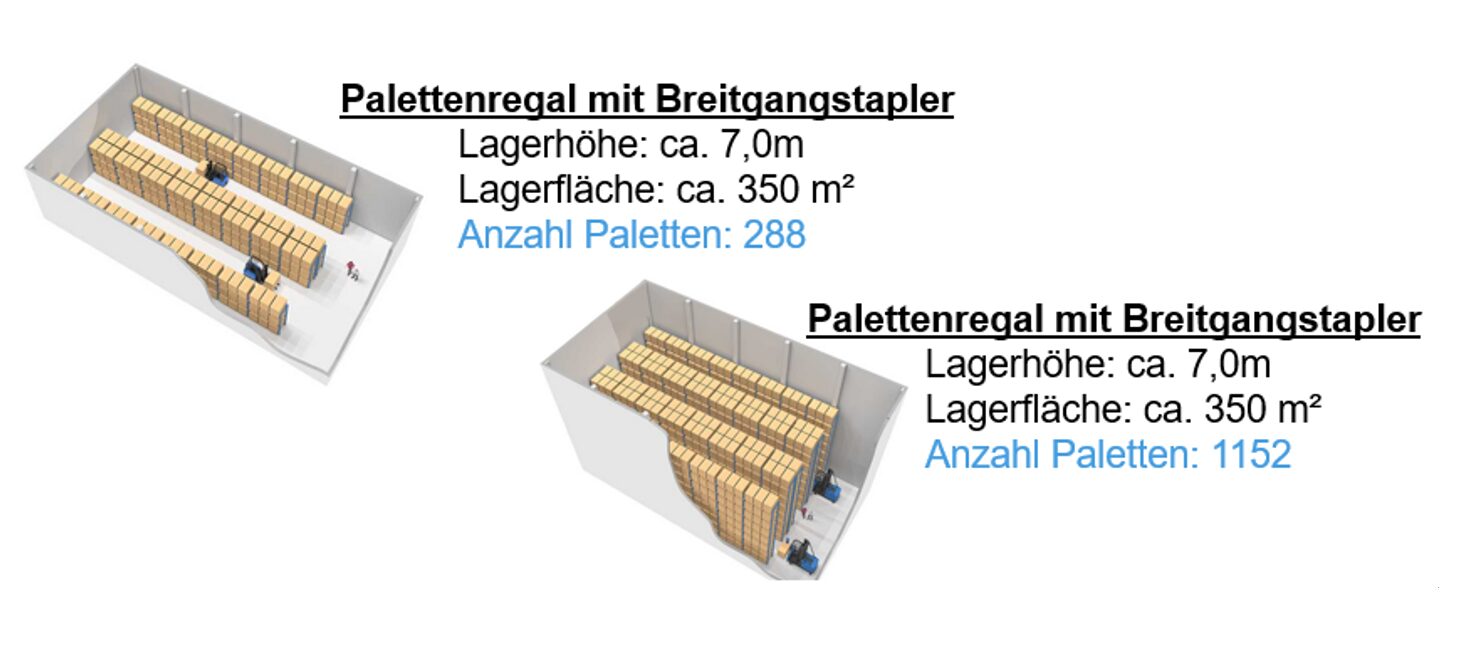
Narrow-aisle warehouses with AGVs place certain demands on the structural and technical equipment of the warehouse. On the one hand, the aisles must be sufficiently narrow and at the same time allow the AGVs to navigate safely and precisely. A level and stable floor is crucial to ensure smooth driving operations. Furthermore, a reliable infrastructure for communication and navigation is required, e.g. WLAN, QR codes, magnetic tracks or laser navigation.
The warehouse management system (WMS) must be able to control the AGVs efficiently and integrate them into the higher-level logistics processes. Sufficient charging or changing stations for the vehicles must also be planned. A comprehensive safety architecture is also required to ensure autonomous operation around the clock.
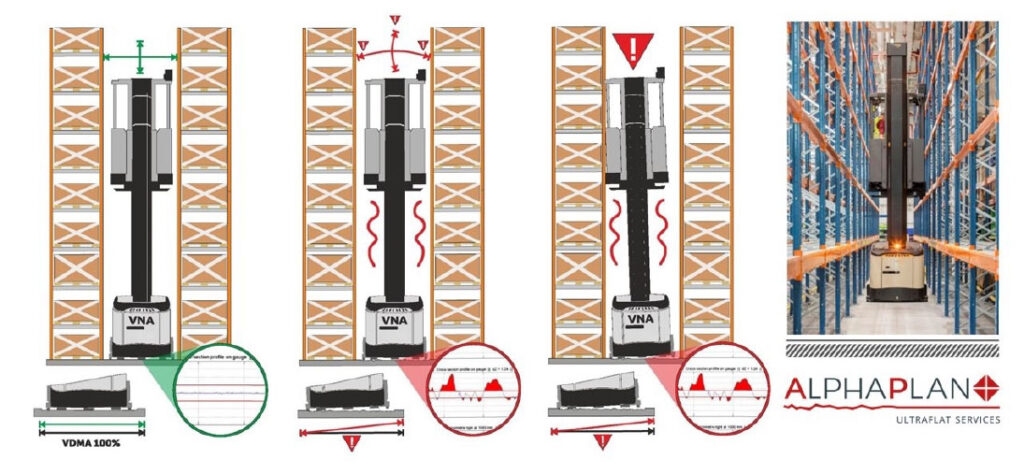
A very helpful system in this context is the Active Floor Compensation (AFC) system, which compensates for uneven floors in real time by actively compensating for measured height differences in the lanes. The vehicle frame remains horizontal and the mast vertical. In comparison to passive damping systems, the AFC system prevents vibrations before they occur – as a result, maximum performance is possible even at high speeds in narrow-aisle warehouses without cost-intensive floor renovation.
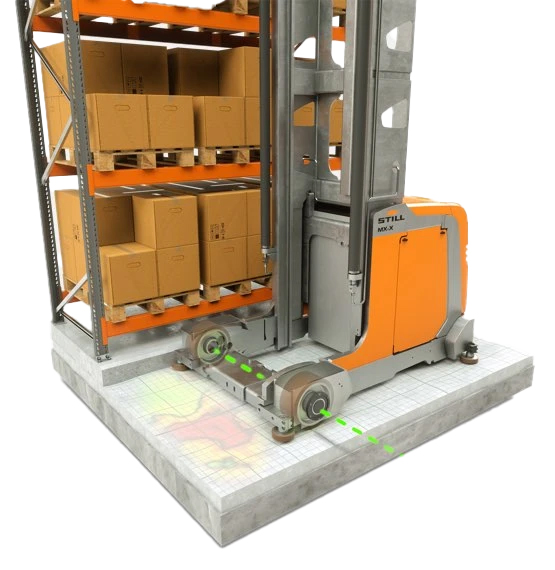
The performance of a narrow-aisle warehouse with AGVs depends heavily on the number and speed of the vehicles used. As a rule, a single AGV achieves a handling capacity of around 10 to 25 pallets per hour, depending on the travel distance, the lifting height and the system layout. However, AGV systems can be scaled flexibly, e.g. by integrating additional vehicles, which can optimize the overall performance. In comparison, storage and retrieval machines (SRMs) in a high-bay warehouse (HBW) typically handle 30 to 40 pallets per hour per machine. The performance is even higher for shuttle systems, which can achieve up to 60 pallets per hour under optimized conditions.
While RGB and shuttle warehouses offer higher peak performance, narrow-aisle warehouses score points with lower investment costs, greater flexibility and better adaptability. They are particularly suitable for warehouses with varying throughput requirements or frequently changing layouts.

Manager, Hamburg
His focus is on production technology. His experience and knowledge include production management, factory planning, value stream mapping, lean management, intralogistics planning and change management.



Senior Manager, Munich
The industrial engineering graduate advises his clients on issues relating to warehouse and logistics planning and the digitalization of logistics (particularly in the ERP, WMS and TMS environment). He also provides clients with comprehensive support in the areas of operations management and strategy.
In our blog series on production optimization, we present practical strategies for shortening throughput times…
Recirculating systems are compact, automated storage systems for fast access, high efficiency and optimum use…
Would you like to set up a new production site? In this article, we show…
You need to load content from reCAPTCHA to submit the form. Please note that doing so will share data with third-party providers.
More InformationYou are currently viewing a placeholder content from Turnstile. To access the actual content, click the button below. Please note that doing so will share data with third-party providers.
More InformationYou are currently viewing a placeholder content from Facebook. To access the actual content, click the button below. Please note that doing so will share data with third-party providers.
More InformationYou are currently viewing a placeholder content from Instagram. To access the actual content, click the button below. Please note that doing so will share data with third-party providers.
More Information