Ensuring product quality with the Control Plan
Do you have problems ensuring your product quality? Do you have to carry out a…
BLOG
Many production sites today face a fundamental conflict of objectives: Existing factory structures need to become more efficient and productive, yet buildings, equipment, and processes cannot be easily redesigned. Structures that have evolved over the years dictate material flows, space utilization, and production processes. Changes must therefore fit into the existing system.
The transformation becomes particularly challenging when operations must continue during the restructuring phase. New structures and technologies must be integrated without compromising delivery capacity or quality. At the same time, investments should not only eliminate short-term bottlenecks but also enable the long-term development of the site.
This raises the question of how established factories can be systematically developed further. Plant structure planning plays a central role in this process, as it considers production, logistics, and IT together and derives the future production strategy from this integrated view.
Successful factory transformations do not result from individual investments, but rather from the interplay of processes, logistics, IT, and organization.
Philipp Kappus, Senior Manager
Many brownfield projects begin with a specific operational problem. A production area is no longer sufficient, material flow paths are too long, or a particular area is overloaded. The obvious response is to eliminate that very bottleneck.
Such individual measures may be useful in the short term. However, if they are planned independently of one another, a structure often emerges over the years that, while consisting of many individual optimizations, does not function optimally as an overall system.
Our experience with plant planning and transformation projects across various industries reveals a recurring pattern: Companies invest in individual technologies or process improvements without fundamentally questioning the underlying plant structure.
For example, this can result in new equipment increasing productivity in a single area while simultaneously requiring additional transportation or buffer stock. Even a new logistics solution can lose its effectiveness if the production structure is not aligned with the resulting material flows.
The key perspective, therefore, is not to optimize individual areas, but to view the factory as a whole system.
Only when production, intralogistics, and IT systems are considered together can a robust, forward-looking concept for the facility be developed. This involves much more than simply the layout of machines and workstations. Production principles, the degree of automation, material supply, inventory levels, scheduling parameters, and digital control must also be coordinated. n IT and departmental resources are limited; therefore, it should not be the loudest process that wins, but rather the one with the best balance between feasibility and impact.
A layout describes where machines, workstations, storage areas, and traffic routes are located. However, forward-looking factory planning must begin one step earlier.
The key question is: What kind of plant structure does the company need to implement its production strategy over the long term?
This raises a number of questions. What role should the site play in the production network going forward? How will the product portfolio evolve? What level of vertical integration makes strategic sense? What production and assembly principles are best suited for the future production program?
The choice of automation level must also be considered in this context. It is also necessary to determine how material flows and intralogistics should be organized, what role IT systems and scheduling parameters play, and how inventory levels and buffers can be appropriately sized.
The layout is therefore not the starting point for factory planning, but rather the result of overarching planning.
Furthermore, a plant structure should not merely reflect the current state of affairs. A long-term planning horizon is particularly crucial in brownfield projects. If a site must be adapted again within a few years because the solution that has just been implemented cannot be scaled up, this results in additional investments, relocations, and operational constraints.
Factory planning is not a layout project. It is the physical implementation of a company’s production strategy.
Florian Domeier, Senior Consultant
Brownfield projects are among the most challenging transformation initiatives in manufacturing companies. Existing structures must be further developed, while production must remain as stable as possible at the same time.
In practice, however, similar mistakes occur time and again. The causes often lie less in individual planning details than in the fundamental approach.
Brownfield projects are transformation projects carried out while operations continue, and therefore require a clear structure, a solid basis for decision-making, and a business case.
Philipp Kappus, Senior Manager
A visible problem often leads people to start planning the layout right away. Insufficient space, inefficient pathways, or overloaded assembly areas are specific challenges for which a spatial solution is sought quickly.
In the process, strategic issues are easily overlooked.
What role should the facility play in the production network in the future? How will the product portfolio evolve? What level of vertical integration makes sense in the long term? What automation strategy is the company pursuing?
If these questions are not addressed before the layout is planned, the current state is often simply optimized. The result may look better in the short term, but it may not align with the future production strategy.
A layout should therefore always be based on the strategic and production-related requirements of the future plant.
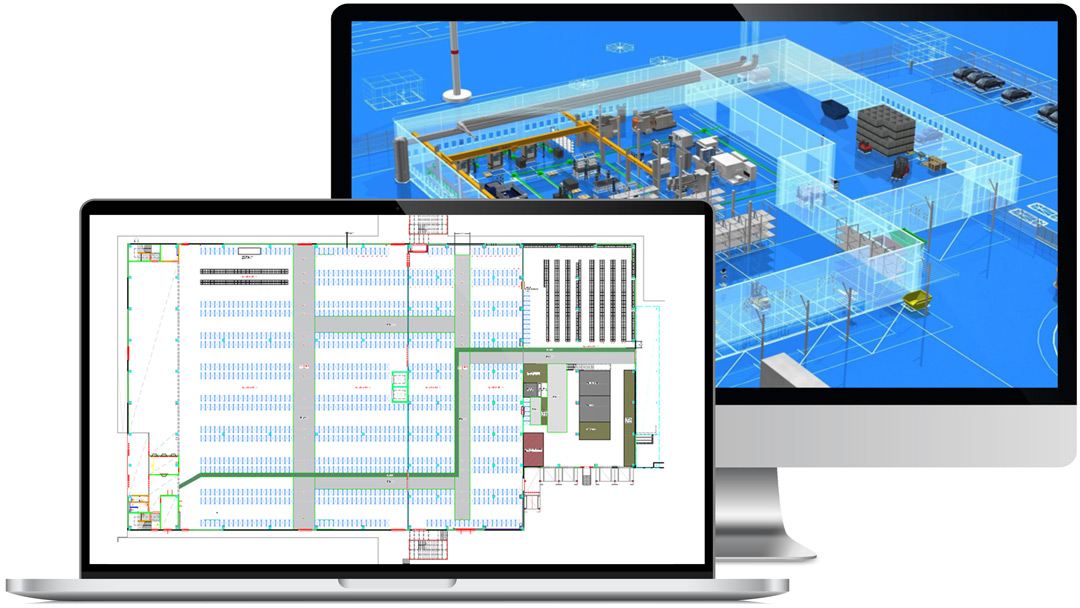
Established factories rarely undergo change as a result of a single major planning initiative. Often, individual areas are expanded, new facilities are added, or logistics spaces are adapted in response to specific operational needs.
Each individual measure builds on the existing situation. Without a long-term perspective, this eventually results in a patchwork of individual decisions.
The consequences can be significant: material flows become unnecessarily long and complex, transportation costs rise, and inventory levels increase. Machinery or workstations may not be utilized to their full capacity. At the same time, the site’s scalability is limited.
This can also result in repeated relocations. Areas must be reorganized because the previously established structure no longer allows for further development. Every change places additional strain on day-to-day operations.
That is precisely why a brownfield plant structure should not be designed to last only for the next few years. A planning horizon of at least ten years provides the necessary long-term perspective.
Automation is not an end in itself—it is a business-case decision.
Florian Domeier, Consultant
Robotics, autonomous transport systems, and AI-powered planning systems offer great potential. They can improve productivity, quality, and transparency in production systems.
Nevertheless, technology is not an end in itself.
If automation is considered in isolation from the production system, there is a risk of confusing technological possibilities with actual requirements. A solution that makes economic sense in one production environment is not necessarily the right choice under different conditions.
Factors such as the dynamics of the production program, the variety of models, and the required flexibility all play a role in the decision. Cost-effectiveness over the entire life cycle is equally important.
Automation is therefore a business-case decision. What matters is not what technology is generally available, but rather what economic and structural contribution it can make within the future production system.
Digital architecture indirectly contributes to the design of the factory.
Florian Domeier, Senior Consultant
The physical structure of a factory and its digital control systems cannot be planned independently of one another. Nevertheless, in factory projects, the IT architecture is often not considered until a later phase of the project.
IT systems have a direct impact on production and logistics processes. For example, scheduling parameters affect inventory levels and lead times. Planning systems influence lot sizes and production sequences. Shop-floor systems, in turn, determine how transparent and controllable the processes are.
If IT is not taken into account until after the essential structures have already been established, inconsistencies may arise between physical processes and digital control logic. This can also result in inefficient interfaces between the systems involved.
Digital architecture thus plays an indirect role in the factory’s design. It should therefore be integrated into the plant layout planning at an early stage.
In established production structures, there are often buffer areas and inventories that have developed over time. What was originally intended as a short-term solution to a specific problem eventually becomes an integral part of the production system.
However, buffers are not inherently inefficient. When used correctly, they can stabilize production systems and decouple processes from one another.
However, this requires careful planning. This includes, among other things, defining decoupling points, analyzing bottleneck logic, implementing appropriate scheduling strategies, and setting clear service level targets.
Without such a systematic approach, large inventories can build up without actually making the processes more stable. At the same time, capital is tied up and additional space is required.
Buffers should therefore be viewed as strategic leeway rather than as a byproduct of the existing factory structure.
Buffers are strategic leeway—not byproducts.
Philipp Kappus, Senior Manager
A brownfield transformation often takes place while operations are ongoing. That is precisely what makes the implementation particularly challenging.
New equipment must be integrated, processes must be modified, and IT systems must be adapted. At the same time, production cannot simply be interrupted for an extended period.
If the risks of this transition phase are underestimated, it can lead to production instability, schedule delays, and increased coordination efforts. Especially when it comes to major changes, it is therefore not enough to simply plan the target structure.
Implementation must be taken into account as early as the conceptual phase. A realistic transformation roadmap is necessary to coordinate individual measures effectively and minimize the impact on ongoing operations.
These common mistakes are counterbalanced by a few clear principles for success. First and foremost are strategic guidelines that define the requirements the future plant structure must meet.
Building on this, production, logistics, and IT should be considered as an integrated whole. Decisions regarding technologies and automation are not made in isolation, but rather based on their cost-effectiveness and how they fit into the production system.
Another important point is the structured development of different variants. Instead of settling on a single solution as early as possible, various plant structure variants are developed and evaluated for feasibility and cost-effectiveness.
The subsequent implementation should also be taken into account at this stage. A realistic transformation roadmap ensures that the planned target structure not only works on paper but can also be implemented step by step in a live production environment.
This methodological framework is complemented by sound change and project management. After all, a factory transformation not only changes floor space and equipment, but often also processes and responsibilities.
This leads to six key principles for success:
A sustainable plant structure is not created by optimizing individual areas in isolation. Only the interplay of production strategy, material flow, intralogistics, IT, and organization creates a resilient overall system.
Anyone wishing to further develop an existing plant should therefore not start by asking which new technology can be used. The first step is to determine what requirements the site will need to meet in the future and what plant structure will be necessary to achieve that.
How concrete variants can be developed, evaluated, and economically compared is the subject of the white paper “ Successfully Transforming Brownfield Factories. “ The paper goes on to delve deeper into topics such as the economic determination of the degree of automation, modern intralogistics solutions like automated guided vehicles (AGVs), the influence of scheduling parameters and IT systems, and the dimensioning of buffers and inventory.
A sustainable plant structure is not created through individual investments, but through the coordinated interaction of production, logistics, IT, and organization. A holistic brownfield planning approach lays the foundation for the targeted further development of existing structures, the rigorous evaluation of investments, and ensuring the site remains efficient and flexible in the long term.
Would you like to find out how you can adapt your existing factory structure to meet future challenges? We’re here to help!

Senior Manager, Frankfurt
Philipp Kappus has gained extensive hands-on experience in factory, production, and machinery planning at a wide range of companies. He has been managing the Rothbaum office in Frankfurt since 2019.



Senior Consultant, Hamburg
His areas of focus include process mining, lean production, process management, and logistics planning. Among other things, he has contributed to projects on production optimization using process mining and has conducted training sessions following the implementation of Celonis.
Do you have problems ensuring your product quality? Do you have to carry out a…
The Upstream® system from GEBHARDT is a flexible shuttle storage solution for efficient and sustainable…
How attractive is Eastern Europe as a production location in 2025? Find out everything you…
You need to load content from reCAPTCHA to submit the form. Please note that doing so will share data with third-party providers.
More InformationYou are currently viewing a placeholder content from Turnstile. To access the actual content, click the button below. Please note that doing so will share data with third-party providers.
More InformationYou are currently viewing a placeholder content from Facebook. To access the actual content, click the button below. Please note that doing so will share data with third-party providers.
More InformationYou are currently viewing a placeholder content from Instagram. To access the actual content, click the button below. Please note that doing so will share data with third-party providers.
More InformationYou are currently viewing a placeholder content from reCAPTCHA. To access the actual content, click the button below. Please note that doing so will share data with third-party providers.
More Information