Practical guide supplier manual
Are you receiving deliveries in unwanted load carriers, outside the desired time window or with…
INTERVIEW SERIES GLOBAL OPERATIONS FOOTPRINT
The “Global Operations Footprint” interview series sheds light on the many facets of global networks – from location strategies and supply chain architectures to digitalization and leadership issues. The focus is on the experiences and perspectives of proven managers who provide insights into their strategic considerations and practical decision-making processes.
Our aim is to make each topic tangible through personal stories, well-founded assessments and best practices. Our interviewees show how companies shape their global value creation structures, what principles guide them – and how global networks are evolving under the influence of technological, geopolitical and market changes.
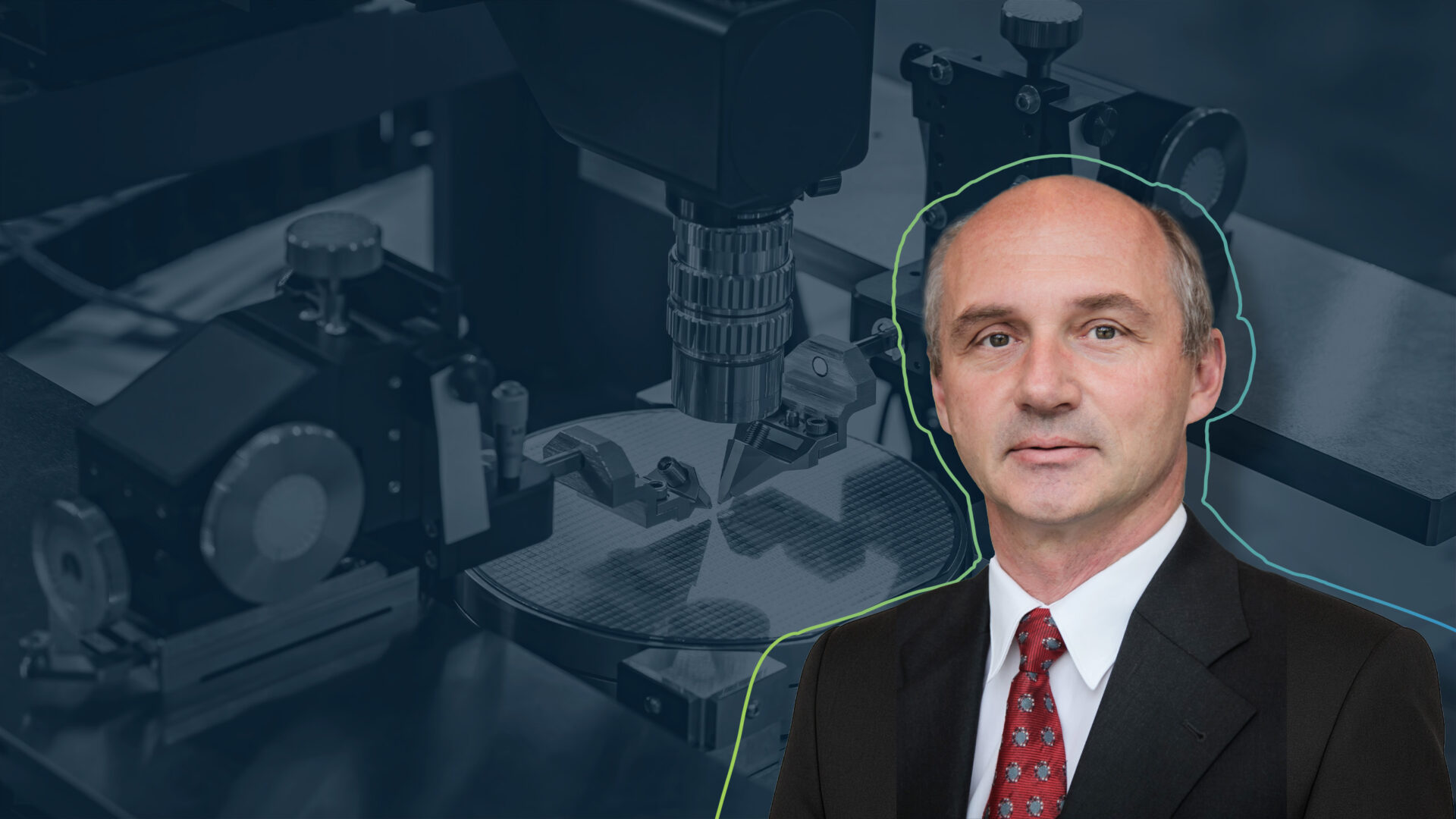
The interview with Peter Dressler focuses on how Infineon Technologies AG has optimized its global transport logistics for transparency and risk minimization in times of geopolitical uncertainty.
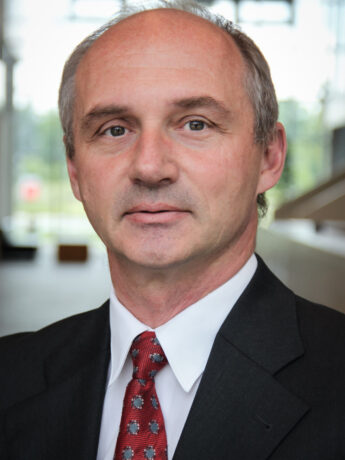
Supply chain and logistics expert, formerly Vice President
Peter Dressler is an experienced supply chain and logistics expert with over 30 years of management experience in the industry. Most recently, he was Vice President Supply Chain at Infineon Technologies, where he was responsible for global logistics structures and successfully implemented complex M&A integrations – including Cypress Semiconductor and International Rectifier.
At Infineon, we differentiate between production and distribution networks. Production is global – front-end is highly capital-intensive, back-end is labor-intensive and therefore often located in Asia. This division means that we are constantly flying material around the world.
We rely on three major hubs in our distribution network: Europe, Singapore and China – with Singapore playing a special role. From there, we can serve both the Western and Asian markets well. The location was chosen deliberately: politically neutral, excellent infrastructure, high reliability.
Air freight is therefore not an exception or even a luxury, but a necessary part of our system – and without it, our schedules would simply not be sustainable.
Air freight is indispensable for us. The semiconductor industry is often about speed and precision – and air is the only way. Of course it’s expensive. But we have no alternative if we need to get material quickly from the front end to the back end or from the distribution center to the customer. You can’t just say: “We produce everything locally now.” That’s not how it works in this industry. And in critical situations – think of lockdowns or restricted airspace – you realize even more how important strong partners in the air are. It’s not the cheapest provider that counts, but who can really do it.
The pandemic and the so-called chip crisis have made it clear that resilience does not begin in logistics, but in the structure of value creation. Incidentally, logistics itself was not the cause of the so-called chip crisis. The causes lay elsewhere: customers ordered too late and relied too much on their market power.
What we have learned logistically in these times: Our network structure must be geopolitically resilient. We deliberately expanded Singapore, for example, because we can operate flexibly in both directions from there – USA and China. It wasn’t the crisis that changed our logistics, but the geopolitical shifts that became apparent as a result. The pandemic was therefore also an accelerator for structural developments in our network.
The pandemic has proven it: It is not enough to simply rely on the cheapest provider. Resilience comes from expertise, reliability – and long-term, resilient relationships.
Peter Dressler, supply chain and logistics expert, former Vice President at Infineon Technologies
The pandemic was not a wake-up call, it was a stress test – and it has shown that our model works. The decisive factor was and is that we do not rely on 4PL or blind outsourcing, but on partnership-based relationships with service providers who understand our processes and think along with us in an emergency – on an equal footing. That was worth its weight in gold during the pandemic.
Singapore is another example: our cooperation with Schenker and Singapore Airlines has secured our air freight capacities. Of course, not all service providers had the same opportunities everywhere – but that’s exactly why you need a network that is spread over several shoulders. We had to get goods with a sales value of over 500 million euros out of China. Without coordinated partners, internal expertise and a forward-looking logistics center in Frankfurt as an alternative location, this would have failed.
The pandemic has proven it: It is not enough to simply rely on the cheapest provider. Resilience comes from expertise, reliability – and long-term, resilient relationships. This has proven its worth, and we will not give it up – even if the purchasing department then of course justifiably looks at the price again.
Transparency has always been important to us – but the requirements have increased. We used to map a lot of things using our own solutions. That is no longer possible today. Now we rely on professional solutions. We started with JDA and Transvoyant, but didn’t have the support we wanted. Now we rely on SAP and p44. Here, too, not all that glitters is gold.
However, the challenge remains the IT heterogeneity on the service provider side: different systems at different locations – at DHL, for example – require continuous readjustment. But without real-time information, you can no longer manage globally. Our service providers are therefore obliged to automatically transmit track-and-trace information to our systems. The goal is comprehensive exception management: deviations from the defined process should be escalated. Getting there is challenging, but crucial for operational excellence.
The central control principle at Infineon is exception management. I don’t care whether a package takes three or five days – as long as it’s on schedule. But if it is foreseeable that something is going to go wrong, then I want to know about it. We have set target transit times for each route. If this is missed, we are automatically notified – and a logistics manager intervenes before customers are affected.
Of course, we also look at early warning systems: Weather, strikes, geopolitical developments. A lot is possible in terms of technology. But you have to be able to run before you can train sprinting. We have deliberately built up step by step. The medium-term goal is to establish an intelligent system that proactively identifies risks and suggests alternative routes.
Geopolitics is the white elephant in the room today. And we have to accept that the world has changed. People used to think that free trade and global thinking would go on forever. Today, it is clear that there is a return to the formation of camps. Infineon therefore took measures at an early stage to make the network more robust. One example is the decision to use Singapore as a central distribution location. Although Singapore is cost-intensive, it offers political neutrality and excellent logistical connections to all relevant markets – especially China and the USA. In an environment of increasing bloc formation, this flexibility is a strategic advantage.
At the same time, we examine whether technological duplication is necessary for each region – for example, different standards for the Chinese and US markets. These developments require long-term planning and geopolitical scenario analysis. Today, we have to set up networks in such a way that we can still deliver even in the event of rapid political decisions. And that is only possible with foresight and structure. Panic doesn’t help anyone.
Yes, there are – but as always, it depends. Take the Singapore-Frankfurt route, for example, one of our most important. Of course we have looked at alternatives: Munich, Amsterdam, Paris – all physically feasible. But there are tax, customs and accounting implications. This is not an issue that you can “just switch over”. Therefore: backups exist, they are prepared – but not actively in regular operation, they are activated when required.
The situation is similar on the origin side. Singapore is a special case. If staff are absent there, the military is ready within hours to maintain critical infrastructure. No other location in Asia can do that. In China, on the other hand, we are looking at overland alternatives to Hong Kong or new dedicated airports for express services inland.
What must be clear: With our volume, nothing is done manually. The transport control is fully system-based. A route cannot simply be changed ad hoc without intervening in the system logic. This is why alternative routes must not only be physically available, but also on the IT side and regularly checked.
It’s about know-how, networking and understanding local requirements.
Peter Dressler, supply chain and logistics expert, former Vice President at Infineon Technologies
When I look at how our customs team has developed – from a few people to a global organization – you can see what is needed. It’s not about processing more forms. It’s about know-how, networking and understanding local requirements. We don’t rely on agents or service providers. In China, for example, we now have our own customs team – because I’m not prepared to trust blindly in such an environment. If you operate globally, you have to be anchored locally – with your own people. And they have to be close to the authorities, partners and, of course, our internal processes.
This dovetailing is essential. Customs, legal, SCM – we don’t work in silos. When new regulations are introduced, we automatically coordinate them. Customs provides the assessment, Legal checks what needs to be done, SCM adjusts the routes and Government Affairs provides context. Everything that we physically change is mapped in the system beforehand – otherwise it will blow up in our faces. That costs resources, yes. But it ensures our ability to act – even in the event of short-term changes. And above all, we retain control. That has always been important to me. External parties help, but the responsibility lies with us.
Definitely. Today, we are seeing a fragmentation of global trading areas that no one would have seriously thought possible ten years ago. The political reality – whether China strategy, America First or America Only – is forcing us to rethink.
For certain product groups, this means double supply chains. One for China and its block states, one for the “rest of the world”. This is now an operational reality – triggered by geopolitical tensions, customs and subsidy policies, increasing regulatory pressure and even by our customers.
Of course, not every product portfolio can be completely duplicated – but for critical technologies such as AI chips or special automotive components, separate value creation is almost a prerequisite for market access. If you don’t prepare today, you will have a strategic problem tomorrow.
What used to be managed by a central team now requires decentralized expertise in the respective target markets.
Peter Dressler, supply chain and logistics expert, former Vice President at Infineon Technologies
The complexity has exploded. You used to export a product and that was that. Today, you have to meticulously document the origin, customs status, end use, embargo-relevant content and regulatory declarations for each destination country. Topics such as export controls, sanctions lists, Taiwan declarations and supply chain law are added on top.
What used to be managed by a central team now requires decentralized expertise in the respective target markets. After all, whether a product originating from Taiwan can be imported into China now depends not only on its origin, but also on the exact wording on the delivery bill. For these reasons, our export and customs teams have grown significantly in terms of personnel.
One key point is that you need local expertise. We have our own employees in the most important countries, not agents. They understand the local regulations, maintain contacts with the authorities and manage the service providers – that makes a huge difference. Secondly, without digital mapping of all movement flows in real time, it is simply no longer possible to manage operations on a global scale. Thirdly, interlinking is crucial. Customs, SCM, Legal and Government Affairs work closely together at our company because a new customs regulation has an impact on storage locations, transportation routes and cost structures. If you don’t think about this in an integrated way, you are constantly running into problems.
It is therefore worth taking a look at the semiconductor industry, especially for export-oriented sectors such as mechanical engineering or automation technology. Not to blindly copy – but to specifically adopt what fits structurally.
M&A is not an isolated case in the semiconductor industry, but the rule. And it almost always means integration at a high level of complexity. Integration must be well thought out in operational and tax terms – otherwise the knock-on effects will tear the project apart.
In the USA, some companies let acquired units run side by side – that is not Infineon’s approach. We didn’t want isolated solutions, but a uniform management capability. That’s why we focused on deep integration, for example with the acquisitions of International Rectifier and later Cypress Semiconductor: IT, processes, warehouse, planning logic. However, we only took over production sites if the technology and condition were right. This approach takes time and is complex, but it brings strategic advantages. The decisive factor is that you need a clear plan, coordinated with Finance, Tax and Legal. Otherwise you will get bogged down.
I think so. The semiconductor industry knows how to deal with highly distributed, capital-intensive networks and a high proportion of external production. Principles such as modular value creation, central planning logic and strongly IT-supported exception management help enormously. This can be adapted – even in mechanical engineering or the automotive industry. However, it is important not to cherry-pick individual ideas. If you want to introduce real-time tracking, for example, you also need the processes behind it. You have to understand how the overall system works – otherwise it will remain an expensive gimmick.
Mr. Dressler, thank you for the interview!
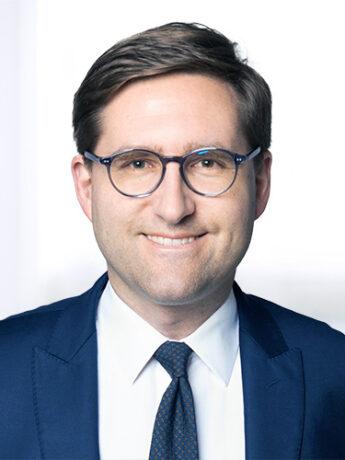
Senior Manager, Hamburg
Kai Philipp Bauer studied mechanical engineering with a focus on production technology and has been working in consulting for over 15 years. He advises his clients in particular on issues relating to strategy development, operations management and digital transformation.

Are you receiving deliveries in unwanted load carriers, outside the desired time window or with…
Germany is currently facing several economic challenges. How can these be overcome with the help…
AutoStore is one of the leading automated storage systems. Find out how the system increases…
You need to load content from reCAPTCHA to submit the form. Please note that doing so will share data with third-party providers.
More InformationYou are currently viewing a placeholder content from Turnstile. To access the actual content, click the button below. Please note that doing so will share data with third-party providers.
More InformationYou are currently viewing a placeholder content from Facebook. To access the actual content, click the button below. Please note that doing so will share data with third-party providers.
More InformationYou are currently viewing a placeholder content from Instagram. To access the actual content, click the button below. Please note that doing so will share data with third-party providers.
More Information