Complexity management with product mining
Product Mining is a new, data-driven platform technology to make complexity management in manufacturing companies…

BLOG
The efficient control of multiple plants is an ever-increasing challenge for manufacturing companies with heterogeneous system landscapes. This can be remedied by using an MES as a strategic orchestrator of production, moving away from the classic “store floor data collector”. Improved transparency, uniform master data and reporting as well as standardized processes are the basis for mastering the increasing complexity in variants or supply chains, for example.
A “next level MES” is modular, API-capable, cloud-ready and multi-plant capable. The classic monoliths are being replaced by data-integrated solutions that fit the company. With a multi-site approach, plants can be linked to form a coordinated production network. As a result, capacities are better utilized, bottlenecks are identified more quickly and processes are harmonized across locations. The advantages are therefore obvious: lower operating costs, greater flexibility in production control and therefore a sustainable increase in competitiveness.
If you digitize waste, you end up with… digital waste! Lean is more relevant today than ever, because clear standards, stable processes and clean material flows form the basis for short throughput times, low inventories and high efficiency. Real-time information from ERP and MES with automated data analysis helps to identify deviations. They also help to control increasingly complex and volatile plant structures. In short: digital tools make lean faster, more precise and more measurable.
Many production companies are currently facing pressure to operate their existing structures more efficiently and to meet increased requirements (e.g. greater diversity of variants) rather than growing quantities. Achieving this without investing heavily in new buildings and extensions increases competitiveness and has a positive impact on sustainability. Targeted plant structure planning makes it possible not only to use existing space much more efficiently, but also to improve material flows and shorten distances. Well thought-out layout adaptations, modular work areas and optimized logistics processes increase productivity with manageable investments and at the same time create the structural basis for digital technologies and future automation.
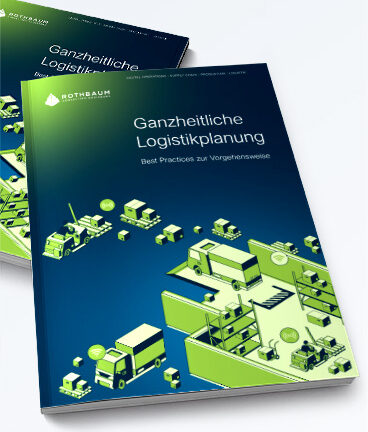
Risk-oriented logistics planning means consistently considering material flows, inventories and logistics and transportation networks from the perspective of disruptions, uncertainties and extreme events. Instead of “one-dimensional” cost optimization, resilience, redundancy and responsiveness are coming to the fore, for example through scenario planning, alternative routes, multi-sourcing or regional hubs. The aim is to ensure service levels and delivery capability even under volatile conditions. For example, due to changes in customer or supplier behavior, bottlenecks in logistics, production and transport capacities or geopolitical risks in general.
Automation and robotics focus on the physical efficiency and stability of logistics processes. The entire technological bandwidth is available, e.g. from automated small parts warehouses to shuttle systems and AMR/AGV fleets. They address the shortage of skilled workers, rising labor costs and quality requirements by mapping recurring, error-prone activities in a technically stable and scalable manner. At the same time, they enable new layout and operating concepts (e.g. dark/light-out warehouse), which not only significantly improve space utilization, but also throughput times and process reliability.
Another top topic for 2026 is AI-supported logistics management, which uses data and algorithms to plan requirements, inventories and capacities in advance and thus automate operational decisions. Applications range from forecasting and dynamic scheduling to slotting optimization and the intelligent use of resources in warehousing and transport. This makes decisions faster, more consistent and more transparent. Logistics is evolving from a reactive “fire department function” to a proactive, data-driven control center.
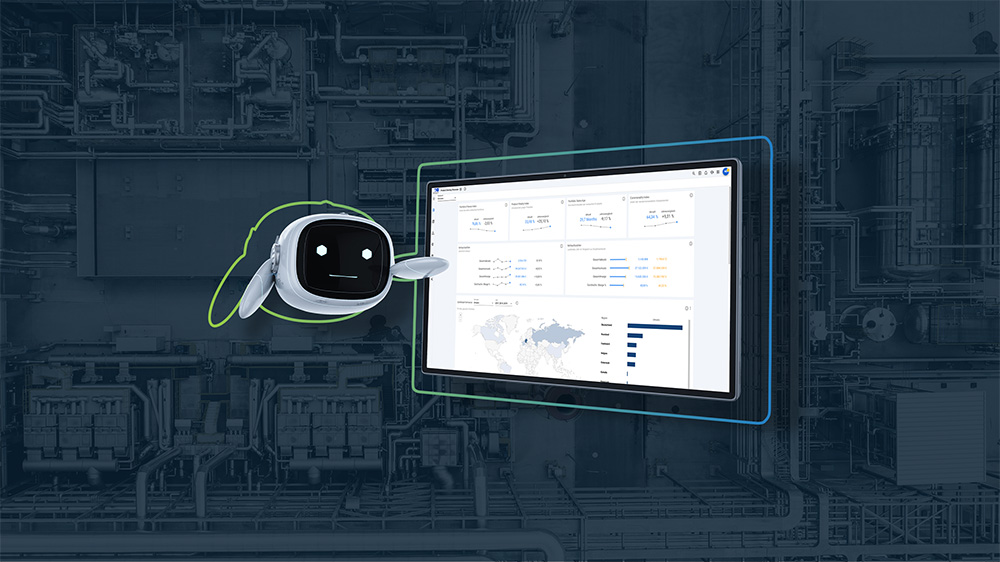
AI will become an integral part of operational decisions in 2026. In addition to traditional machine learning applications, AI agents that autonomously monitor and control defined tasks in planning, production and logistics are increasingly emerging. They identify bottlenecks, forecast requirements or prioritize orders and trigger actions directly – based on real-time data from ERP, MES and IoT systems.
The result: reaction times are reduced, transparency is increased and operational teams are significantly relieved. Companies are moving away from reactive firefighting logic towards proactive, self-optimizing operations that make complexity manageable and create stability in volatile environments.
Many companies struggle with historically grown, heterogeneous IT/OT landscapes. In 2026, the harmonization and integration of these systems will be a key success factor. API-capable architectures, clean master data models and a consistent end-to-end information flow connect ERP, MES, WMS and store floor data to form a standardized digital operations platform. The result: fewer interface problems, isolated solutions and manual coordination, but scalable processes, higher data quality and the basis for automation, AI and multi-site control. This makes smart integration a structural enabler of modern resilient value creation.
Data-driven operations create the basis for fast, reliable decisions in volatile production and supply chain environments. With modern tools such as process mining, IoT data integration or digital twins, end-to-end processes can be made fully visible for the first time: From machine performance and intralogistics material flows to higher-level order fulfillment. Instead of “perceived smooth-running processes”, hard, fact-based decision-making bases are created, including bottleneck identification, throughput time transparency and automated performance monitoring. Companies thus increase their operational stability and create a resilient basis for optimization, automation and AI-supported control.
A key challenge is that existing ERP landscapes are slowing down innovation, growth and efficiency. While global competitors are accelerating their processes with cloud ERP, AI automation and modular architectures, European manufacturers need to leverage their structural strengths – customer proximity, quality and agility. This requires an ERP that creates transparency and reduces complexity, as well as enabling innovation. Modernization is not a technical upgrade, but a strategic repositioning of value creation. Only those who consistently transform their digital basis now will remain manageable and at the same time ensure long-term competitive strength.
Volatile markets, rising costs and complex supply chains are putting European manufacturers under massive pressure. To remain competitive, companies need to modernize their operational systems, from warehousing to production and transport logistics. Modern WMS, MES and TMS solutions enable real-time control, automated processes and data-based decisions. The right choice of system becomes a lever for efficiency, speed and resilience. Only those who consistently digitalize and network their operations remain able to deliver, flexible and productive.
2026 will be a decisive year for the SAP landscapes of European companies. Many companies are in the midst of transformation, but real added value will only be created when S/4HANA, the Business Technology Platform and AI-supported process automation work together seamlessly. Integrated, cloud-based architectures are becoming the key to seamlessly connecting data, harmonizing processes and enabling innovation directly from the standard. AI-supported assistants, automated workflows and a consistent clean core create the basis for speed, scalability and operational excellence. Those who see SAP as a holistic business platform rather than just an ERP upgrade will be able to exploit the full innovation potential next year and achieve clear competitive advantages.
The trade policy of the new US administration poses enormous challenges for many companies: High import tariffs, margin losses, legal uncertainty and a lack of predictability. After a period of waiting, the time will come in 2026 when many companies will have to adapt their supply chain to the new conditions. Localization of value creation in the USA, new distribution concepts or even cooperation models? New, flexible strategies are needed for industrial supply chains.
The current market situation is putting companies under high cost pressure. AI-supported forecasting models in sales planning and end-to-end, integrated planning processes can help to optimize capacity utilization and inventories while at the same time better meeting demand. Modern software solutions support the S&OP process and connect it seamlessly with operational planning and control processes. Our experts will show you which software is right for your company.

Senior Manager, Frankfurt
Philipp Kappus has gained in-depth practical experience in factory, production and machine planning at a large number of companies. The industrial engineer has headed the Rothbaum office in Frankfurt since 2019.



Senior Manager, Munich
The industrial engineering graduate advises his clients on issues relating to warehouse and logistics planning and the digitalization of logistics (particularly in the ERP, WMS and TMS environment). He also provides clients with comprehensive support in the areas of operations management and strategy.

Manager Digital Operations, Frankfurt
He is responsible for the Digital Operations business area at Rothbaum. His goal is to drive digitalization forward with our customers from the manufacturing industry and to support operations with modern technologies and system solutions.

Manager, Munich
As a manager, Dominik leads various projects, particularly in the areas of factory planning, business process optimization in production and supply chain as well as digital operations.

Senior Manager, Hamburg
Kai Philipp Bauer studied mechanical engineering with a focus on production technology and has been working in consulting for over 15 years. He advises his clients in particular on issues relating to strategy development, operations management and digital transformation.
Product Mining is a new, data-driven platform technology to make complexity management in manufacturing companies…
Sustainability is increasingly becoming a game changer for corporate success. Based on specific use cases…
Are you facing the challenge that your customers are demanding goods in ever smaller quantities?…
You need to load content from reCAPTCHA to submit the form. Please note that doing so will share data with third-party providers.
More InformationYou are currently viewing a placeholder content from Turnstile. To access the actual content, click the button below. Please note that doing so will share data with third-party providers.
More InformationYou are currently viewing a placeholder content from Facebook. To access the actual content, click the button below. Please note that doing so will share data with third-party providers.
More InformationYou are currently viewing a placeholder content from Instagram. To access the actual content, click the button below. Please note that doing so will share data with third-party providers.
More Information