



Avoid material bottlenecks with resilient supply chains
Challenges such as container and semiconductor shortages or port closures are leading to line stoppages…

Blog
ERP systems are complex and often outdated. The list of well-known examples of failed ERP implementations is long. In these projects, the selection of the ERP system and the right implementation partner is of great importance.
Over the past few years, Rothbaum has assisted several clients in selecting new business software solutions. These solutions explicitly include not only ERP systems, but also systems for warehouse management (WMS), production planning (PPS), and manufacturing execution (MES). Today, I would like to share the insights I have gained from these experiences with you.
If you are currently in the process of selecting an ERP system, I would like to provide you with a guiding framework in the following article, drawing repeatedly on our practical experience. This report does not claim to be exhaustive, but rather aims to highlight the points that I consider particularly important for you to consider.
Operations Process Consulting focuses on value-adding processes.
Dominik Fackler, Manager
But now let’s get to the content. The structure of this article broadly follows the general phases of project management, from initiation and planning through execution and monitoring to project closure.
Overview:
Selecting and implementing an ERP system is a marathon. Thorough preparation is essential!
Dominik Fackler, Manager
Careful planning of the selection process and subsequent implementation is one of the success factors that must be mentioned in connection with ERP implementations.
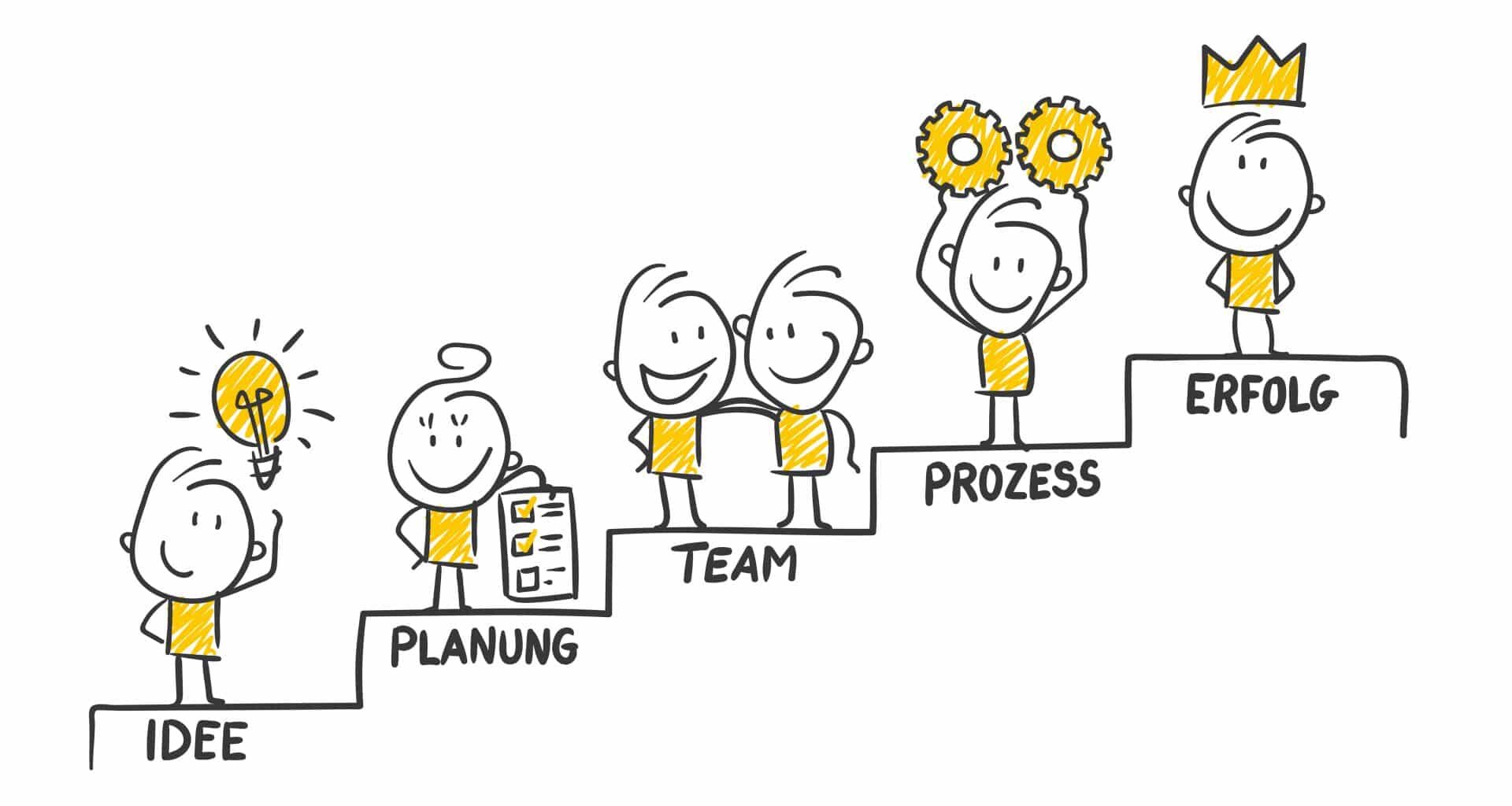
Before you begin gathering requirements and modeling processes, you should address the following tasks, among others.
What expectations are associated with switching ERP systems? There are numerous legitimate reasons for switching ERP systems. The following are often cited as such:
It is important to establish and document a shared understanding of these management requirements and objectives. As stakeholders, management must understand the necessity of the project and make its implementation a priority.
This also includes providing the necessary resources. After all, you wouldn’t want to go without refreshments along the route during a marathon.
Dominik Fackler, Manager
Selecting the right professionals to support the project is essential. A balance between the practical knowledge of existing work processes—which the so-called business experts bring to the table—and a willingness to improve the status quo is indispensable. At the latest during the training sessions prior to go-live, all stakeholders will become familiar with the solution. The employees involved in the selection process therefore also play an important role in the change process; they serve as the voice of the solution within the organization—the so-called evangelists.
In addition to the internal team, external support is often brought in. Selecting and implementing new business software is a pivotal decision that will shape and guide your company for years to come. Rothbaum regularly assists clients in selecting business software and is therefore well-versed in conducting and facilitating the selection process. At the same time, we bring process expertise and knowledge from various industries to the table, ensuring that the selection process always focuses on your company’s value-adding processes.
Changing your ERP system will have a direct impact on how your employees will work together in the future. To effectively manage this aspect of the change, proactive communication from the very beginning is key. Later on, options such as consultation hours with project members or an in-house information session or fair are also possible. The goal is to shape the transition in such a way that your employees support the changes and move from being affected parties to active participants. To achieve this, it’s important that they don’t (only) learn about the changes in the break room.
According to a study by Fraunhofer IAIS, implementing a new ERP system takes one to two years on average, with a quarter of the companies surveyed taking longer than two years. If you factor in the time required to select a system, it becomes clear that the project will keep you busy for an extended period.
The selection process should be viewed as a milestone; your organization must have enough stamina to run the marathon. It is important that everyone involved shares a similar understanding of the time frame to avoid disappointment.
Often, the need for a new ERP system isn’t just identified today. Certain specialists are tasked with drafting a requirements specification, and the document grows over the years—yes, years—yet it is never completed because day-to-day operations never stop, there are no established contacts with system integrators, or the necessary expertise is lacking.
Can you write up a set of requirements for a complete ERP system? Neither can I. But with off-the-shelf software, that’s not necessarily required. Here’s why.
Dominik Fackler, Manager
In my experience, a requirements specification in the traditional sense isn’t always necessary. Across the board, minimal customization—or, to put it positively, a high degree of standardization—is cited as a key success factor for ERP implementations. How is a system vendor supposed to respond to a requirements specification that, based on the legacy system, sets parameters that make the standard solution impossible across the board without even considering it? A traditional requirements specification clashes with the desire for a standard solution.
Nevertheless, requirements must be documented and communicated. Without a basis for comparing providers, no decision can be made. More on requirements gathering in the next section.
To initiate the vendor selection process, we regularly prepare request for proposal (RFP) documents as part of our consulting projects. These documents serve several purposes: They document the requirements for the new system while also establishing the framework for comparing vendors. The following section highlights several business analysis methods that we use to create specific sections of the request for proposal. If you are interested in learning more about business analysis methods, I recommend the BABOK v3 business analysis guide or a seminar offered by ibo.

Is a particular business process or stakeholder part of the new system, or should it be excluded? The scoping phase defines the framework for the system replacement. A scope map enables the creation of technical or organizational interfaces. Other insights from the scoping phase include “no-go areas”—that is, system areas that should not be affected by the new system.
Scope modeling can be further refined with regard to the interaction between different systems. A system landscape illustrates which systems communicate with one another and what information flows between them. A dynamic analysis from the current state to the target state also clarifies which data sources will be replaced. It is important that, in the end, there is a shared understanding of which areas are being phased out and with which systems the new system provides technical or organizational interfaces.
Processes are at the heart of every ERP system selection. Another blog post takes an in-depth look at best practices in process modeling: Process Management: Our Experience with Tools, Standards, and Training.
In general, it is important to determine which processes can be converted into standard processes. The goal should be to use standard modules in indirect processes, such as accounting.
However, the complexity of value-adding processes—for example, in manufacturing—should be taken into account through a detailed description. Only through the resulting triad of product, process, and system capabilities can value creation be optimized and remain competitive.
Recently, process mining has been gaining traction as a data-driven method for modeling processes and supporting ERP transformation.
Use cases and user stories are two methods of agile business analysis. We use a customized version of use cases to describe problems and business processes that are particularly relevant to the client. In most cases, the scenarios to be considered become more specific as the requirements gathering process progresses. By addressing the use cases during the vendor presentation, the project team gains a good understanding of how critical requirements could be implemented in the new system.
In addition to the methods described, the document includes other components. A realistic timeline that is not met can quickly become a deal-breaker when selecting an integrator. The next steps should also be outlined; for example, in what format should responses to the request for proposal be submitted?
We’ll wrap up this section with a draft request for proposals that can be sent to bidders. But which bidders should we actually consider?
Before the article delves into the evaluation and decision-making process in detail, here are a few words on identifying potential vendors for the new ERP system.
When providing support during the selection process, Rothbaum always acts independently of any specific provider. The providers mentioned are therefore only examples.
Dominik Fackler, Manager
Identifying suitable providers is always an industry-specific task. In glass processing, for example, there are specialized industry solutions from A+W, Fenetech, Hegla-Hanic, and Lisec. Industry solutions typically stand out for their well-designed systems and relatively faster, more cost-effective implementations. They are also often implemented directly by the vendor. Alternatively, cross-industry solutions such as proALPHA or SAP are, of course, also an option. Implementation is usually carried out by an implementation partner.
You can find out which providers are suitable for you through industry contacts, trade shows, or external partners, for example. Once an initial long list of candidates has been compiled, we typically conduct interviews with the individual providers to determine, based on elimination criteria, whether the provider is a good fit for the client (timeline, company size, etc.). This should result in a shortlist of 3–5 providers for the next stage of the selection process.

It makes sense to reach out to vendors even while the request for proposal (RFP) documents are being prepared. It is important to regularly and specifically assess what information is relevant to vendors in the context of an ERP implementation. In this phase, we see ourselves as a neutral facilitator who ensures that all parties involved receive the information they need.
Once the response to the request for proposal has been submitted, the first evaluation begins. Determining whether individual requirements have been met allows for an initial comparison of the bidders. It has proven effective to prioritize individual requirements (e.g., using the MoSCoW method) or for the project team to define deal-breaker criteria.
In addition to responding to the request for proposal, the vendors’ presentations also play a key role. A live demo of the potential new system gives the project team the opportunity to gain a deeper understanding of the improvements the new ERP system will bring, based on use cases prepared as relevant real-world examples.
The evaluation is then based on a wide range of criteria: In addition to functional criteria, cost-effectiveness must also be ensured. At the same time, the vendor or implementer and the client must be on the same page. After all, selecting an ERP system means entering into a long-term partnership.
Before you begin selecting a vendor and implementing the system, I’d like to share a few insights with you. You should keep these points in mind, as they are key factors for success and potential project risks.
Your management must support the ERP implementation and make it a priority. The implementation will be challenging—there’s no question about that. The resources needed for the project must be made available, and resistance must be addressed through active project marketing and change management.
In another blog post , my colleague Dr. Clemens Wolf has already provided an in-depth look at the topic of process management in the context of an ERP implementation and the training aspect.
Certain issues regularly cause friction in ERP implementation projects. These are organizational issues that lie dormant beneath the surface and come to light, for example, during process workshops. Want an example? Returns processes. Time management.

Undefined processes and organizational issues are causing the ERP project to balloon to dangerous proportions. Project managers must set clear boundaries here. It is not the project’s responsibility to develop a standardized methodology for determining standard times, etc. These project risks must be identified in a timely manner and addressed by the project management team or senior management.
I really enjoyed sharing my experiences with you. I hope this article has given you a more comprehensive insight into the challenge of selecting a vendor for an ERP system or similar business software.
Are you just starting the selection process, or are you having trouble at a certain stage? Please feel free to contact me with any questions or comments you may have on this topic.

Manager, Munich
Dominik Fackler is a manager at Rothbaum Consulting Engineers in Munich and is responsible for transformation projects in the areas of business and system transformation. His focus is on the end-to-end optimization of business processes, as well as the selection and implementation of appropriate IT solutions.


Challenges such as container and semiconductor shortages or port closures are leading to line stoppages…
The Exotec Skypod automated storage system combines modern technology with high flexibility - for greater…
Is your production or logistics "excellent"? Especially in Germany, a high-wage country, efficiency and improvements…
You need to load content from reCAPTCHA to submit the form. Please note that doing so will share data with third-party providers.
More InformationYou are currently viewing a placeholder content from Turnstile. To access the actual content, click the button below. Please note that doing so will share data with third-party providers.
More InformationYou are currently viewing a placeholder content from Facebook. To access the actual content, click the button below. Please note that doing so will share data with third-party providers.
More InformationYou are currently viewing a placeholder content from Instagram. To access the actual content, click the button below. Please note that doing so will share data with third-party providers.
More InformationYou are currently viewing a placeholder content from reCAPTCHA. To access the actual content, click the button below. Please note that doing so will share data with third-party providers.
More Information