Three scenarios for the logistics of the future
What will the logistics of the future look like? Current upheavals in the industry are…

blog
Rising labor costs, a growing shortage of skilled workers, and intense competition for qualified employees continue to put pressure on manufacturing companies in Europe. Against this backdrop, Eastern Europe remains an attractive option for many companies, both when searching for a new production site and when expanding existing capacity.
Eastern Europe’s labor market remains very attractive compared to Germany and other Western European countries. At the same time, the general conditions vary from country to country and, in some cases, even significantly between individual regions. Therefore, looking only at national averages does not provide a complete picture.
This article compares monthly labor costs and unemployment rates in selected European countries and regions. It also shows how cost advantages change when not only monthly figures but also the actual hours worked are taken into account.
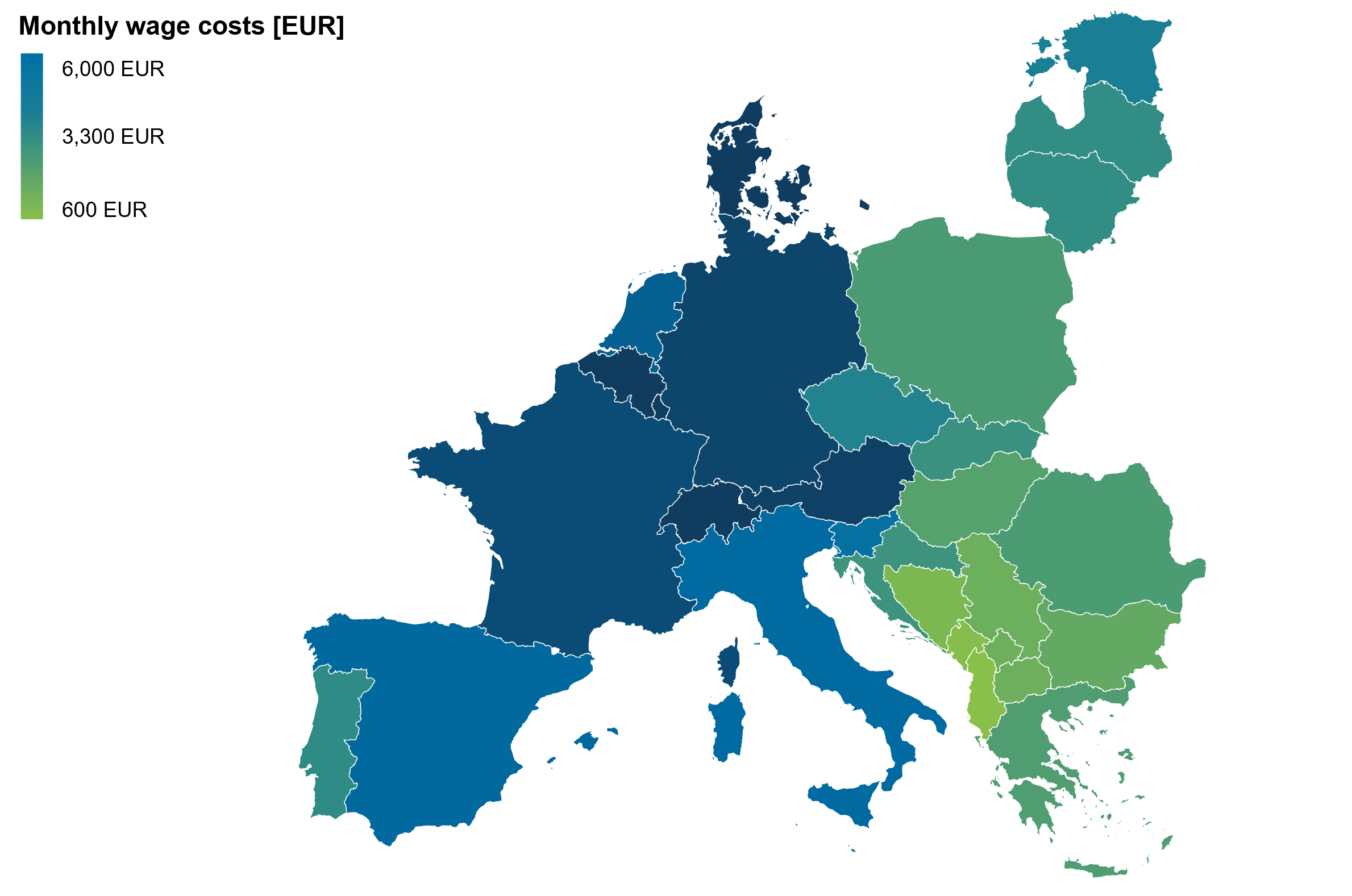
A look at average monthly labor costs reveals a significant disparity within Europe. In Germany, employer costs average 6,500 euros per month. Austria reaches 6,000 euros, while Switzerland, at 9,400 euros, is at an even higher level.
In Eastern Europe, the situation is fundamentally different. Wage costs remain particularly low in the Western Balkans. Albania ranks at the bottom of the comparison with an average of 1,000 euros per month, followed by Bosnia and Herzegovina with 1,100 euros. In Serbia, on the other hand, monthly labor costs amount to about 1,600 euros per month.
There are also significant differences within the EU. Bulgaria averages 1,600 euros per month, while Romania stands at 1,900 euros and Hungary is even just over 2,000 euros. This means that these countries remain significantly below the cost of living in Germany.
In the more industrialized countries of Central and Eastern Europe, costs are already higher. In Slovakia, the Czech Republic, and Poland, labor costs range from 2,500 to 2,700 euros. Slovenia is even higher at 2,900 euros. Nevertheless, these locations remain cost-competitive compared to Germany.
The figures make it clear that Eastern Europe is not a uniform low-cost region. There is a difference of nearly 2,000 euros in monthly labor costs between Albania and Slovenia. For companies, therefore, the question is not merely whether Eastern Europe is a viable option, but whether it is worth taking a closer look at which country and which region best fit their own production strategy.
After reviewing Eastern Europe as a whole, a look at the Balkan states reveals just how much national averages can vary within individual countries. The Balkan states remain among the most cost-effective production regions in Europe. For this reason, a more detailed breakdown is particularly worthwhile here—not only at the national level, but also at the regional level. The differences between metropolitan areas, industrial hubs, and more rural areas are, in some cases, significant.
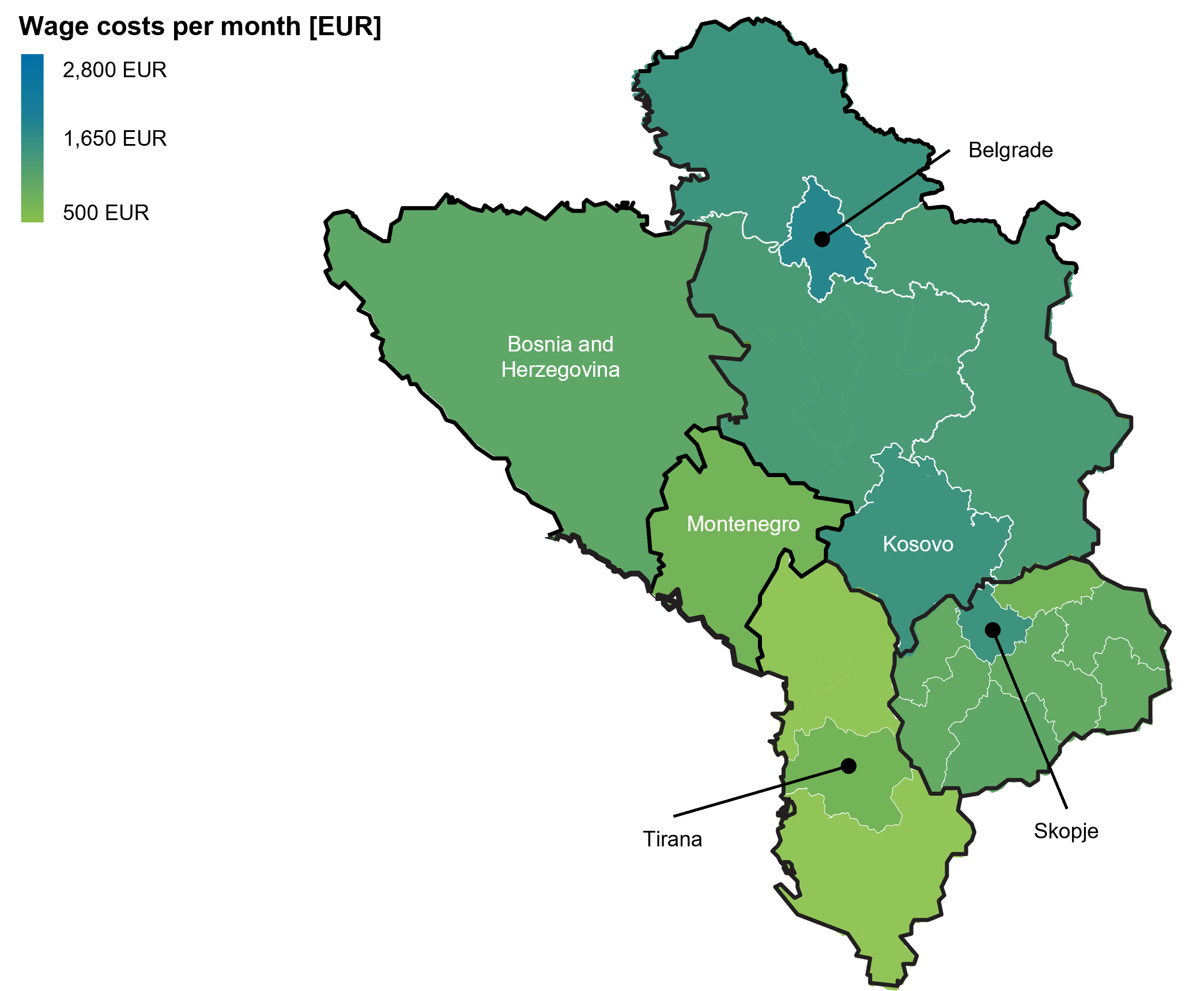
In Serbia, average monthly labor costs amount to 1,600 euros. The Belgrade region, at 1,800 euros, is significantly higher than that. Costs are lower in Vojvodina at 1,400 euros, in southern and eastern Serbia at 1,300 euros, and in Šumadija and western Serbia at 1,200 euros.
The typical pattern is clearly evident here, as the metropolitan area offers a large labor market, good infrastructure, and often a higher concentration of skilled workers. At the same time, however, competition for talent is more intense there, and the cost of living is higher.
This phenomenon is found in most countries, although the differences within a single country are not always very significant. In the Federation of Bosnia and Herzegovina, they are around 1,100 euros; in the Republika Srpska, they are slightly over 1,000 euros; while in the Brčko District, they remain just below the 1,000-euro mark.
Regional variations in Albania follow a similar pattern: While the national average is about 1,000 euros, Central Albania reaches 1,100 euros, and Northern and Southern Albania each stand at about 900 euros. The higher costs in the central region are likely due primarily to the economic importance of the greater Tirana area.
A particularly wide regional range can be found in North Macedonia. Monthly labor costs range from 1,000 euros in the northeastern region to 1,600 euros in Skopje, while the national average is 1,400 euros. This means the capital region is more than 60% more expensive than the least expensive region in the country.
This clearly shows that regions outside the capital can offer significant cost advantages for your project, provided that infrastructure, logistics, and the labor supply are suitable.
For many years, Poland and Romania have been among the most important manufacturing locations in Eastern Europe. Both countries have large labor markets, well-established industrial structures, and extensive experience working with international investors.
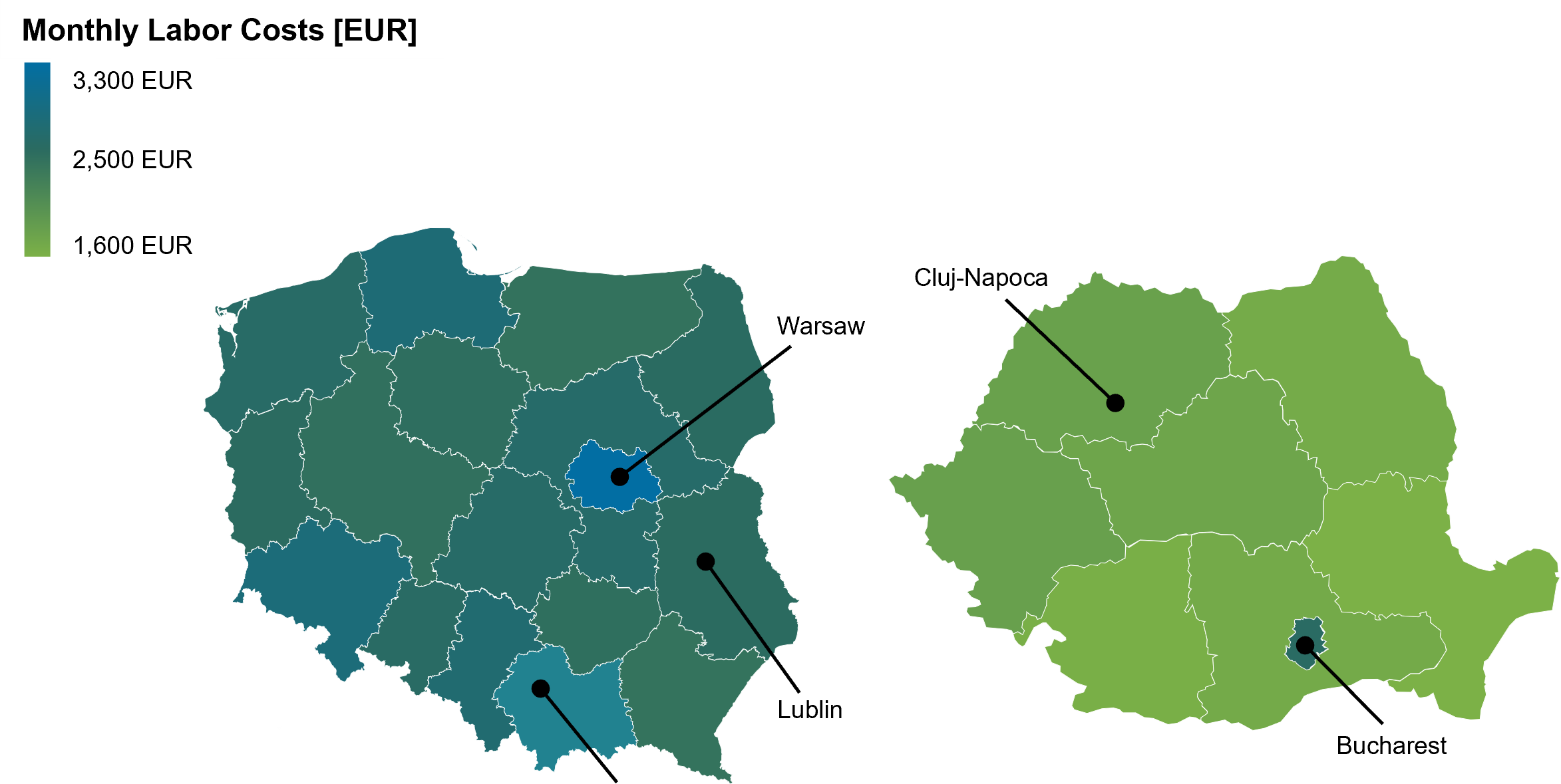
Romania remains comparatively affordable, with average monthly labor costs of 1,900 euros, while strong clusters have developed around established industrial locations. For example, labor costs in and around Bucharest are around 2,500 euros, while in the other regions in the south (Sud-Est, Sud-Muntenia, and Sud-Vest Oltenia) they are below 1,700 euros per month. The western part of the country—specifically the Vest and Nord Vest regions—currently has slightly higher labor costs at 1,800 euros. In Romania, it is therefore clear that access to experienced employees, suppliers, and service providers is available, although the established industrial locations also intensify competition for qualified personnel.
Poland, on the other hand, at 2,700 euros per month, is already noticeably higher than Romania. In return, the Polish labor market offers a broad industrial base, numerous universities, and a well-developed infrastructure. For companies, the higher cost level can make economic sense if it leads to improved productivity, greater security of supply, or shorter ramp-up times.
Here, too, national averages do not adequately reflect regional differences. At the regional level, it is also notable that large metropolitan areas and established industrial centers are generally more expensive and face greater competition for talent. In the Warsaw metropolitan area, for example, labor costs amount to just under 3,330 euros per month. Other regions, such as the Carpathian Foothills, Warmia-Masuria, or Greater Poland, often offer more favorable conditions with labor costs below 2,400 euros, but require a careful assessment of infrastructure, accessibility, and available skills.
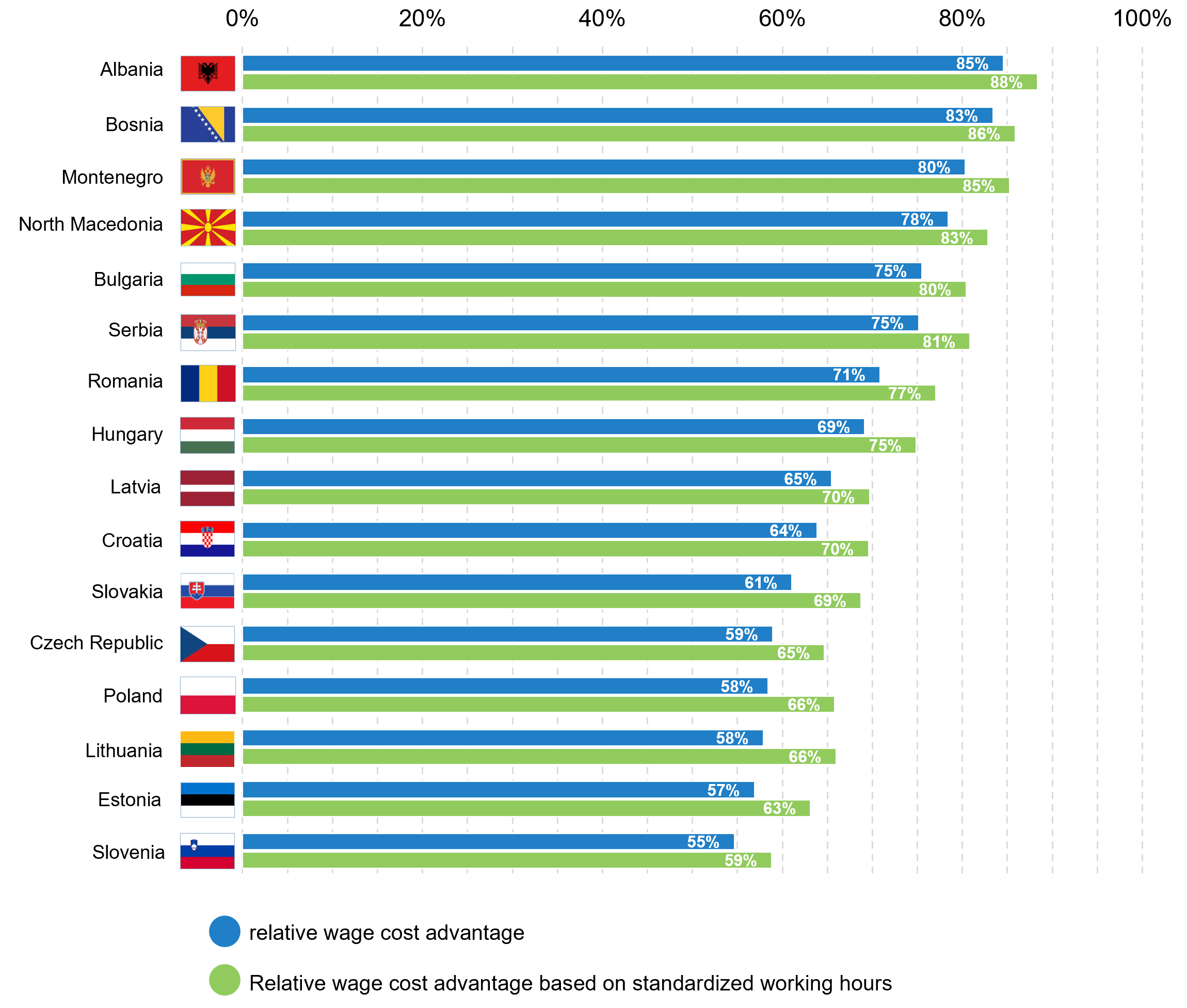
Labor costs in Germany amount to approximately 55.70 eurosper hour worked. All Eastern European countries are significantly below this figure. It is also notable that the Balkan countries have the lowest labor costs per hour worked. These are all below 11 euros, with Albania recording the lowest labor costs at just 6.50 euros.
When available working hours are standardized, the cost advantage of many Eastern European locations increases even further. Albania, for example, then achieves an 88% advantage over Germany. Bosnia and Herzegovina comes in at 86%, Montenegro at 85%, and North Macedonia at 83%. Serbia stands at 81%, Bulgaria at 80%, and Romania at 77%.
Therefore, it is not just the monthly wage that matters, but the cost per productive hour of work. For labor-intensive production processes, this perspective can significantly alter the ranking of potential locations.
A look at the past five years shows, however, that the wage cost advantage over Germany has narrowed. While Eastern Europe remains attractive in terms of costs, the gap between its wage levels and those in Germany has narrowed. This trend is particularly noticeable in Poland, where the relative wage cost advantage over Germany has fallen by 13% over the past five years. Examples such as Romania (-8%) and Albania (-12%) also clearly illustrate this effect. In many countries, wages are rising faster than in Germany, driven in part by inflation, minimum wage adjustments, and increasing competition for skilled workers. For companies, this means that current cost advantages should not be assumed to remain unchanged for the entire lifespan of a production site.
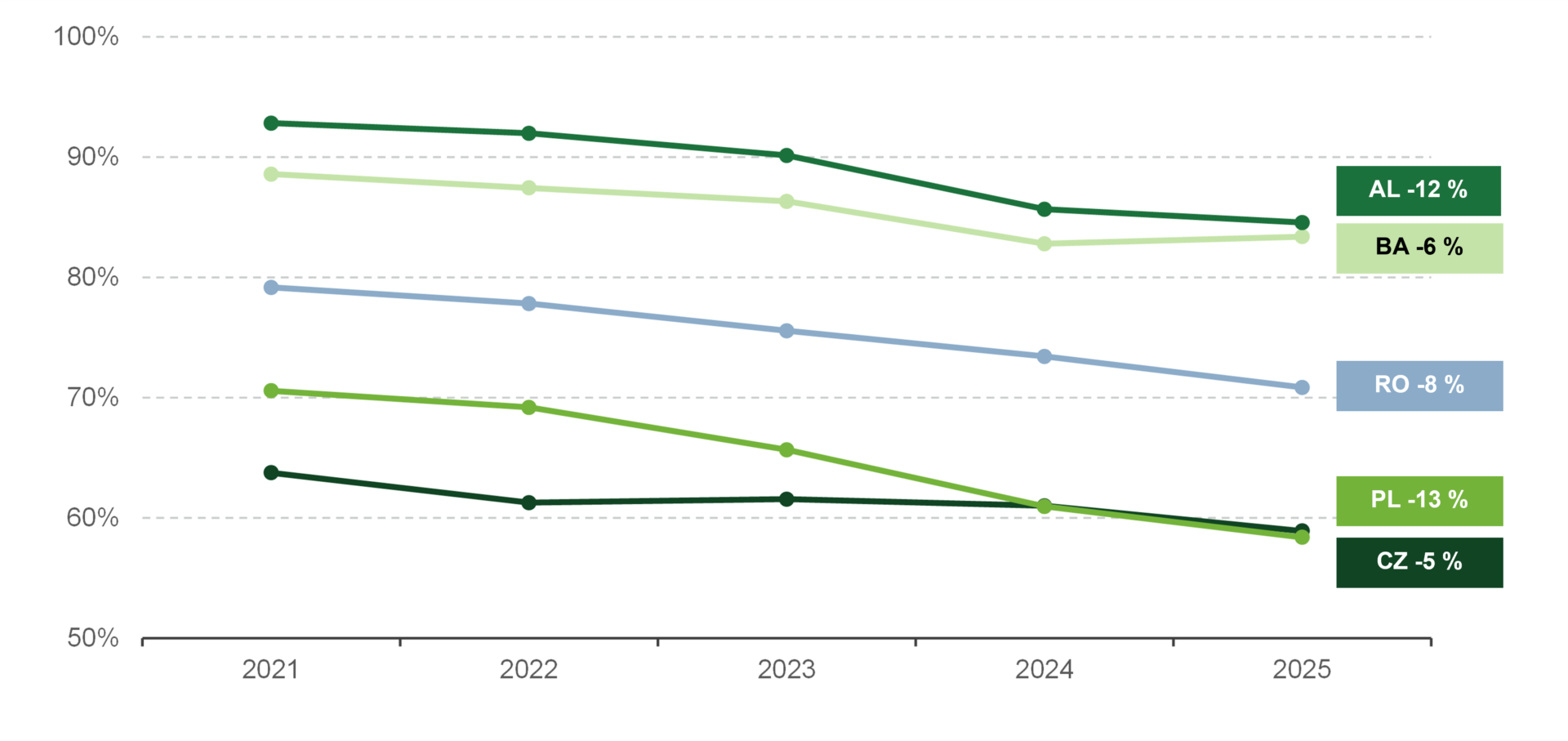
A location should therefore not be evaluated solely on the basis of current cost levels. At least as important is the question of how wages, labor availability, and productivity are expected to develop in the coming years.
Monthly labor costs provide a quick overview, but they are not sufficient for a reliable comparison of productivity and profitability. Vacation days, holidays, weekly working hours, and other absences vary from country to country and affect the number of working hours actually available to a company.
Labor costs are an important factor in choosing a location, but they tell only part of the story. Equally important is whether there is a sufficient labor force available at the potential location.
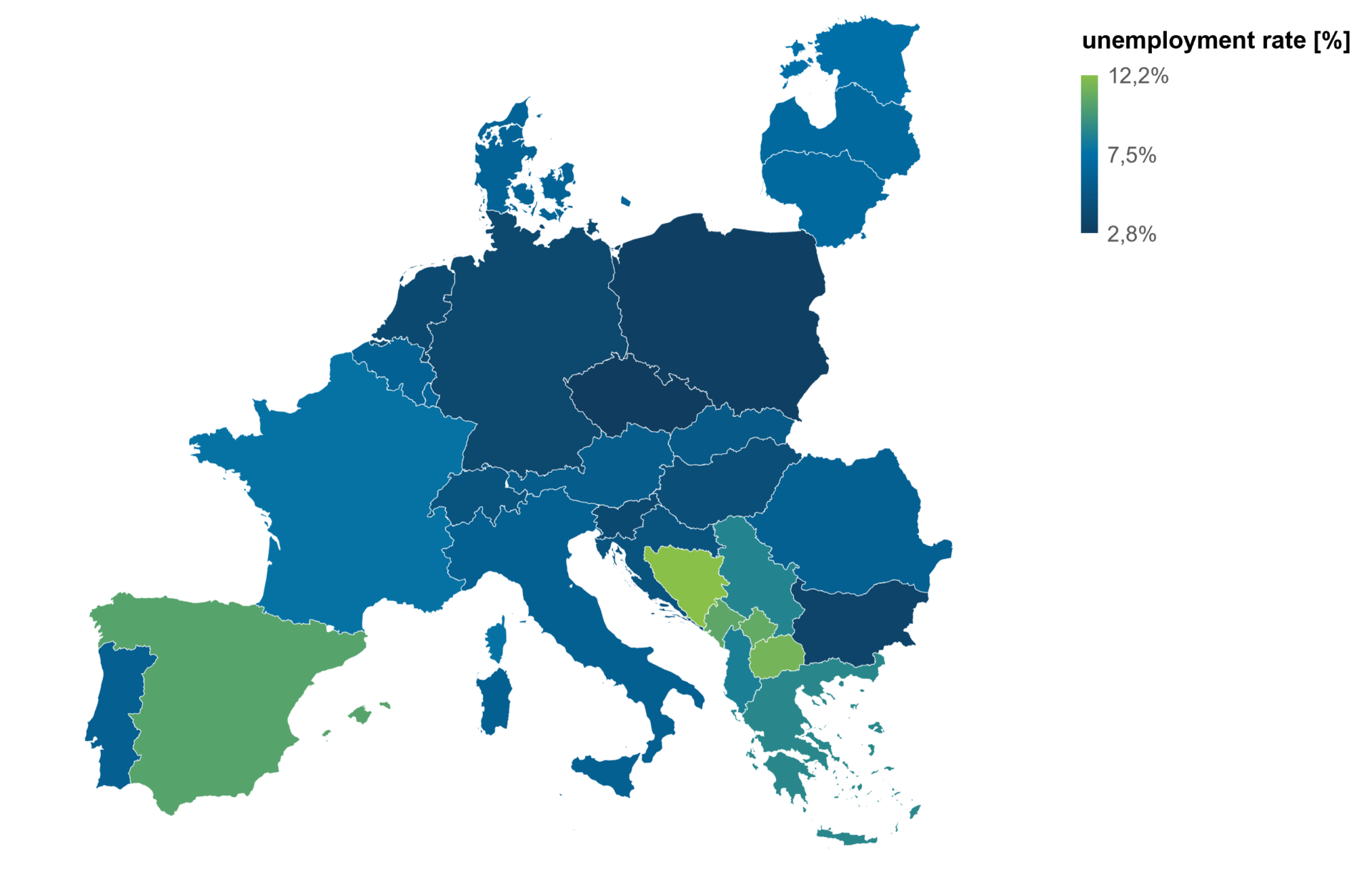
Unemployment rates provide an initial indication of this . In the Czech Republic, the rate stood at just 2.8% in the fourth quarter of 2025 . Bulgaria’s rate was 3.5%, while Germany’s and the Netherlands’ were both 3.9%. Slovenia and Hungary also have comparatively low rates, at 3.9% and 4.4%, respectively.
For companies looking to set up operations, such rates can pose a challenge. While a low rate indicates high employment, it often also means that there are few workers available on the labor market at short notice. New employers then compete with established companies for staff, particularly when it comes to technical specialists and workers with production experience.
The situation in the Balkans is different. Bosnia and Herzegovina has a high unemployment rate of 12.2%, North Macedonia 11.5%, and Montenegro 10.7%. Serbia and Albania also have relatively high rates, both exceeding 8%. In purely mathematical terms, this suggests that there is at least a larger labor force potential in these countries.
A high unemployment rate is not, however, automatic proof of a good supply of workers. The key factor is whether the qualifications, professional experience, mobility, and salary expectations of available candidates align with the planned location. Demographic trends and the ongoing out-migration from certain regions also play a role. The unemployment rate should therefore be viewed as a starting point for analysis rather than a definitive assessment.

Supply Chain Manager
Are you planning to set up a production facility in Eastern Europe, or would you like to optimize your location strategy? We’ll guide you through the site selection process with our many years of expertise and the support of reliable local partners on the ground. Please feel free to contact us.
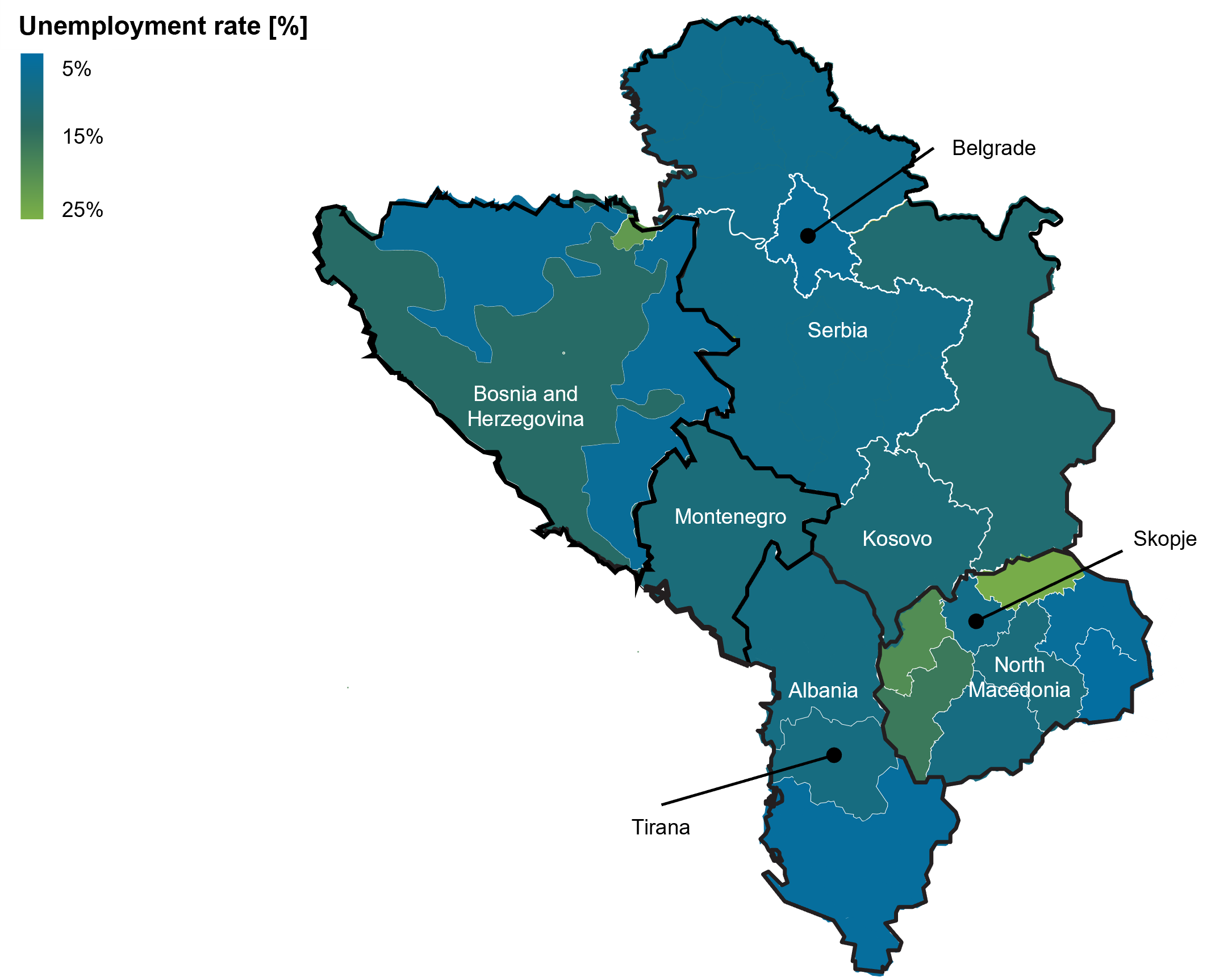
Regional unemployment rates in the Balkans paint an even more varied picture than the labor costs shown here, since in some of these countries, economically strong centers and structurally weaker regions are geographically far apart.
In Serbia, the unemployment rate ranges from 6.9% in the Belgrade region to 11.9% in southern and eastern Serbia. Outside the capital region, there is thus, in theoretical terms, a larger labor force available, coupled with lower labor costs.
The differences are even greater in Bosnia and Herzegovina. The Republika Srpska has an unemployment rate of 6.7%, while the rate is highest in the Brčko District at 21.2%. The fact that Brčko also has the lowest labor costs in the country makes the region particularly attractive at first glance. Before making a location decision, however, it would be necessary to conduct a detailed analysis of which qualifications are actually available and how large the realistic catchment area is.
Regional variation is also enormous in North Macedonia, as the southeastern region has an unemployment rate of 5.3%, while the northeastern region’s rate reaches 24.2 %. The Skopje metropolitan area, with a rate of 8.6%, falls in the middle of the range but has the largest and most diverse labor market in the country.
Albania, on the other hand, presents a more balanced picture. The unemployment rate ranges from 5.9% in southern Albania to 9.8% in central Albania.
This illustrates why a location analysis at the national level can only facilitate an initial shortlist. For actual recruitment, the regional labor market is what matters:
Eastern Europe will continue to offer significant potential for manufacturing companies in 2026, as the Western Balkan states, Bulgaria, Romania, and Hungary, in particular, will continue to enjoy significant wage cost advantages.
However, the most favorable location on paper is not necessarily the best location in practice. Low labor costs can be offset by lower productivity, a lack of qualifications, high employee turnover, or the need for additional training. Logistics, energy supply, supplier structures, the legal framework, and proximity to customers also play a significant role in location decisions.
Conversely, a location that is initially more expensive may prove to be economically superior. Higher productivity, a well-developed supplier network, or greater availability of skilled technical workers can more than offset the higher labor costs.
Therefore, the evaluation should not focus solely on direct personnel costs. What matters here is the total cost per service provided. Only this comprehensive view reveals which location is truly competitive.
Eastern Europe remains an attractive region for new production sites and capacity expansions. The greatest labor cost advantages continue to be found in Albania, Bosnia and Herzegovina, Montenegro, and North Macedonia. Locations in Bulgaria, Serbia, Romania, and Hungary also offer low cost levels coupled with increasingly established industrial structures.
Although Poland, the Czech Republic, Slovakia, and Slovenia are more expensive by comparison, they often offer a more robust infrastructure, larger industrial networks, and broader access to a skilled workforce.
The key finding of this article therefore lies not in a ranking of individual countries, but in the crucial regional perspective. Costs, the labor supply, and the competitive landscape can vary significantly within a single country. Metropolitan areas typically offer large and skilled labor markets but are correspondingly expensive. Regions outside major metropolitan areas, on the other hand, offer greater cost advantages but must be carefully evaluated in terms of infrastructure, accessibility, and the availability of skilled workers.
A well-informed decision on a location combines quantitative data with a detailed on-site analysis. Only when labor costs, productivity, workforce availability, logistics, and long-term development are considered together does it become clear which location is not only advantageous today but will also remain competitive in the future.

Manager, Hamburg
Digital transformation, logistics and plant structure planning are her focus topics as a manager at Rothbaum, alongside supply chain design.


Consultant, Munich
Philip Tenière verbindet einen Hintergrund im Wirtschaftsingenieurwesen (TU München) mit internationaler Industrie- und Beratungserfahrung. Dabei bringt er betriebliche und technische Anforderungen zusammen und übersetzt sie in umsetzbare Lösungen.
What will the logistics of the future look like? Current upheavals in the industry are…
Are you receiving deliveries in unwanted load carriers, outside the desired time window or with…
From the customer's point of view, delivery time and adherence to delivery dates are the…
You need to load content from reCAPTCHA to submit the form. Please note that doing so will share data with third-party providers.
More InformationYou are currently viewing a placeholder content from Turnstile. To access the actual content, click the button below. Please note that doing so will share data with third-party providers.
More InformationYou are currently viewing a placeholder content from Facebook. To access the actual content, click the button below. Please note that doing so will share data with third-party providers.
More InformationYou are currently viewing a placeholder content from Instagram. To access the actual content, click the button below. Please note that doing so will share data with third-party providers.
More InformationYou are currently viewing a placeholder content from reCAPTCHA. To access the actual content, click the button below. Please note that doing so will share data with third-party providers.
More Information