Brownfield Factory Planning: Avoiding the 6 Biggest Mistakes
Existing factories are facing increasing pressure to adapt: a growing variety of product variants, shorter…
BLOG
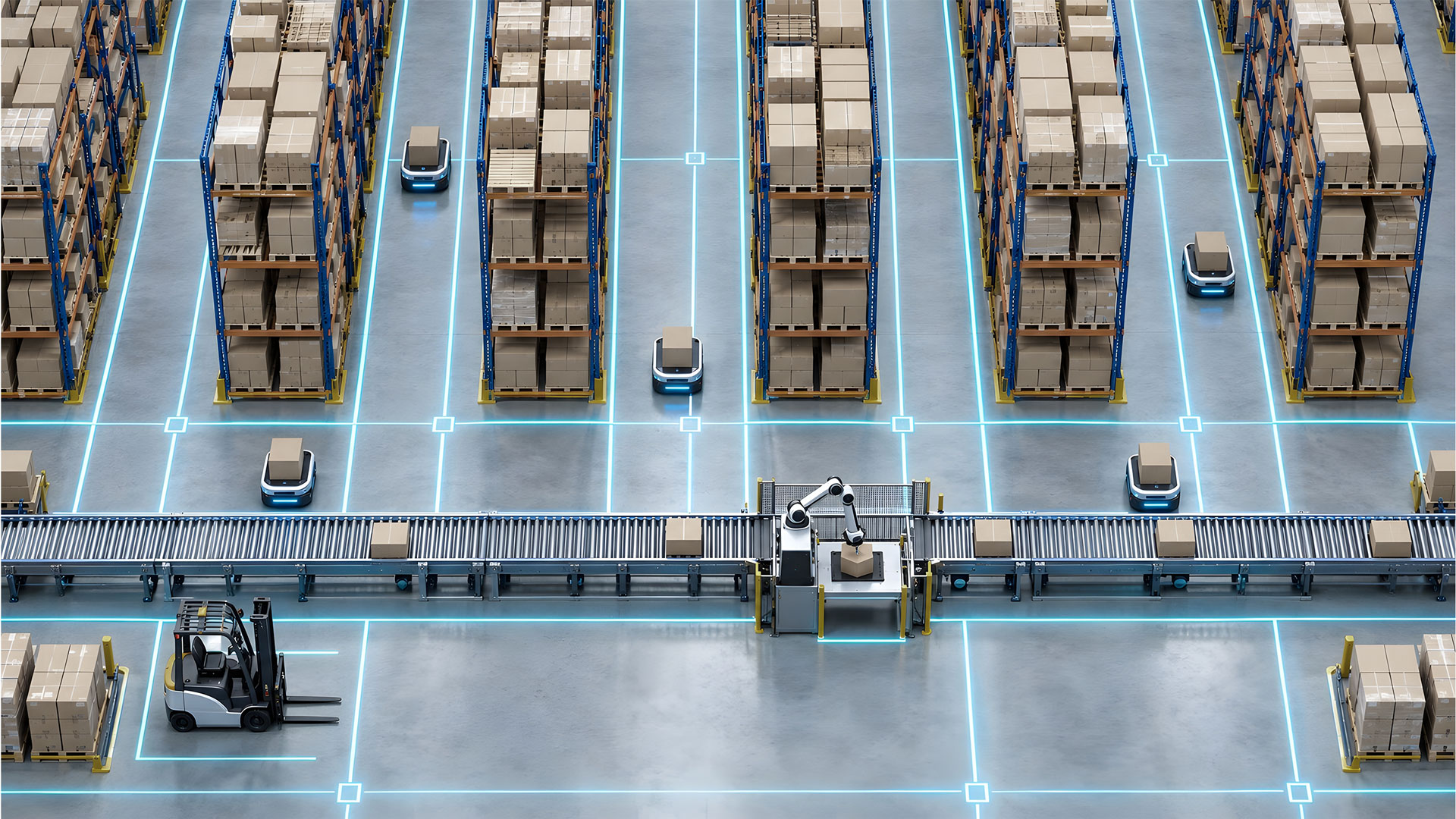
Driverless transport systems (DTS), driverless transport vehicles (DTV), automatic guided vehicles (AGV), and autonomous mobile robots (AMR) are considered key technologies for smart factories and logistics centers. They promise more efficient material flows, greater flexibility, and increased resilience in logistics. At the same time, they open up new opportunities for companies to automate internal transport and further develop existing processes.
However, there is a crucial step between technical potential and successful practical implementation: planning. This is because mobile robotics cannot be deployed independently of the structures in which it will later operate. Material flows, traffic routes, processes, and IT systems have a significant impact on whether a solution achieves the desired improvements. If the implementation is viewed primarily as a technology project, there is a risk of automating existing inefficiencies or creating new interface problems. A high-performance technical solution alone does not guarantee high-performance intralogistics.
It is therefore crucial to view AGVs and AMRs as an integral part of factory and logistics planning. Companies must first clarify the requirements for the overall system. They can then select the appropriate technology and define the necessary structural prerequisites.
Autonomy begins with comprehensive and systematic planning.
Philipp Carl, Geschäftsfeldleiter Logistik & Senior Manager
When companies want to automate their intralogistics, the focus is often initially on the technology. Driverless transport systems and autonomous mobile robots are intended to make transport more efficient, reduce the workload on employees, or increase the flexibility of the material supply chain. However, before deciding on specific systems, it should be clear what contribution automation is expected to make to the company’s development.
Is the goal to reduce transportation costs, improve ergonomics, or make logistics more resilient? Should the solution be able to scale with increasing production volumes or support future changes in the production program? Equally important is the question of which logistics metrics can be used to measure the success of automation.
The answers determine what requirements must be met by the eventual solution. At the same time, they provide the framework for further planning. This includes defining the scope of the project, involving the relevant stakeholders, and clarifying economic and organizational prerequisites. Responsibilities and decision-making processes must also be defined.
Answering these questions early on lays a solid foundation for technology selection and reduces the risk that planning decisions will need to be revised later. Otherwise, additional costs and delays may result.
Without in-depth analysis, there can be no sustainable automation.
Nikolai Ruof, Senior Consultant
Before mobile robotics can be integrated into existing intralogistics, the existing structures and processes must be thoroughly understood. A key foundation for this is the systematic analysis of material flows, spatial conditions, and existing processes and IT systems. Only in this way can one assess what requirements a future transport system must meet and where adjustments are necessary.
The first step is to quantitatively assess internal transport flows. In addition to transport volumes and frequencies, the weights and dimensions of the goods, as well as the load carriers used, are also relevant. Likewise, individual transport routes, seasonal or operational fluctuations, and peak loads must be taken into account. Transports of empty containers and return processes must also be considered, as they generate additional transport movements. The goal is to obtain as accurate a picture as possible of the actual transport volume and its distribution.
In addition to material flows, the structural and infrastructural requirements must also be examined. The layout of the facility and the existing traffic routes determine the available space for movement. Bottlenecks, intersections, and transitions between areas can affect the integration of mobile systems. Added to this are the floor conditions and the question of whether transport takes place exclusively inside buildings or also outdoors. Fire safety and security requirements must be taken into account, as must the interfaces between warehousing and production. In particular, curved sections, transfer stations, and required buffer areas require early consideration, as automated guided vehicles may place different demands on traffic areas than manual transport solutions.
Another component of the analysis is the organizational and IT framework. We examine how companies initiate, prioritize, and schedule transport orders, and which systems manage these processes. In doing so, we also examine the existing IT landscape—including ERP, MES, and WMS systems —as well as the responsibilities for individual processes. What matters is not only which systems are used, but also how the processes function on a day-to-day basis and how quickly those responsible can respond to deviations.
This is precisely where it becomes clear that challenges in intralogistics do not necessarily arise from the transportation itself. Unstable workflows, unclear responsibilities, or poorly coordinated processes can impair the performance of an automated system just as much as spatial constraints.
Only when material flow, infrastructure, and process organization are considered together can a solid basis for decision-making regarding automation be established. The analysis shows which prerequisites have already been met, where action is needed, and which requirements must be taken into account when developing a future logistics and automation concept.
A data-driven analysis replaces assumptions with a solid basis for decision-making.
Philipp Carl, Geschäftsfeldleiter Logistik & Senior Manager

Based on the analysis, decisions will be made regarding how future intralogistics will be organized and how mobile robotics will be integrated into the overall system. The focus is on future material supply, spatial design, and the selection of a suitable automation solution. The goal is a concept that not only automates individual transport operations but also takes into account the requirements of production and logistics as a whole.
Precision in planning prevents costly corrections.
Philipp Carl, Geschäftsfeldleiter Logistik & Senior Manager
In the first step, the company develops the future supply concept. In doing so, it determines how materials should flow between the warehouse, staging areas, and production areas. Depending on the volume of shipments and supply requirements, options such as supermarkets, tugger trains, or direct delivery to individual consumption points may be appropriate. It is also necessary to determine whether material supply should be organized centrally or distributed across several decentralized areas.
Another key focus is on the design of material supply. Well-thought-out buffer strategies and appropriate decoupling points can help absorb fluctuations between individual process steps. This prevents delays in one area from directly affecting downstream supply. The standardization of load carriers must also be taken into account, as uniform formats and defined handoff conditions facilitate automated handling. Decisions regarding the logistics structure play a decisive role in determining which tasks mobile transport systems should perform and how they are integrated into the processes. Therefore, the supply concept should be established first before the technical solution is designed in detail. In this way, automation is guided by the actual requirements of material supply and not solely by the capabilities of individual systems.
Once the future logistics structure has been determined, it is translated into a spatial plan. This includes defining primary and secondary routes, positioning transfer stations, and planning suitable loading and buffer areas. The traffic routes must be laid out in such a way that the mobile systems can reliably perform their transport tasks and the various material flows interfere with one another as little as possible.
The separation of pedestrian and vehicular traffic must also be planned well in advance. Where different types of traffic users intersect, the driving areas and intersections must be clearly laid out. Handoff zones must be arranged so that materials can be safely transferred without disrupting adjacent operations. The design must also take into account the specific requirements of the selected system. While free navigation can provide additional flexibility for autonomous mobile robots, it does not replace a well-thought-out traffic management system.
The safety concept is an integral part of the layout planning. A systematic risk assessment, compliance with relevant standards such as ISO 3691-4, and clear rules regarding speeds and the interaction between people and vehicles form important planning principles. Procedures for handling malfunctions and emergencies must also be established.
Coordinated planning of layout and safety thus creates the conditions necessary for reliably integrating mobile robotics into day-to-day operations.
AGVs should not be viewed in isolation. They are part of a comprehensive logistics and factory concept.
Nikolai Ruof, Senior Consultant
AGVs, AMRs, and automated guided vehicles (AGVs) offer a wide range of opportunities to further develop intralogistics in factories and logistics centers. However, their actual benefits do not depend solely on the performance of the technology used.
The key lies in the interplay between material flows, layout, processes, IT, and organization. By considering these factors together, companies can develop a solution that meets their logistical needs and can be integrated into their existing structures.
Comprehensive factory and logistics planning lays the necessary foundation for this. It helps clarify requirements early on, make well-informed choices about appropriate technologies, and avoid having to make corrections later.
Are you looking to integrate mobile robotics into your factory or logistics center? We can help!

Senior Consultant, Munich
Nikolai Ruof is a trained industrial mechanic, graduate mechanical engineer and senior consultant at the Rothbaum Office in Munich. His areas of expertise include warehouse planning, factory planning and value stream mapping.

Senior Manager, Munich
The industrial engineer advises his clients on warehouse and logistics planning, logistics digitization, and operations management and strategy.

Existing factories are facing increasing pressure to adapt: a growing variety of product variants, shorter…
The lack of space is forcing factory planners to rethink. New innovative concepts must therefore…
Germany is currently facing several economic challenges. How can these be overcome with the help…
You need to load content from reCAPTCHA to submit the form. Please note that doing so will share data with third-party providers.
More InformationYou are currently viewing a placeholder content from Turnstile. To access the actual content, click the button below. Please note that doing so will share data with third-party providers.
More InformationYou are currently viewing a placeholder content from Facebook. To access the actual content, click the button below. Please note that doing so will share data with third-party providers.
More InformationYou are currently viewing a placeholder content from Instagram. To access the actual content, click the button below. Please note that doing so will share data with third-party providers.
More InformationYou are currently viewing a placeholder content from reCAPTCHA. To access the actual content, click the button below. Please note that doing so will share data with third-party providers.
More Information