Automated storage systems: AutoStore
AutoStore is one of the leading automated storage systems. Find out how the system increases…

BLOG
ERP, ticketing systems, various tools—and yet key processes at the interfaces are still handled manually. Approvals via email, master data maintained in multiple places, issues reported verbally. It’s understandable that the desire for workflow automation is growing. The real challenge begins before implementation: Which processes should come first? Many initiatives fail because processes that are too complex or organizationally immature are chosen. After all, digitizing unstable processes accelerates one thing above all else: existing inefficiencies.
In this article, we present a two-step framework that manufacturing companies can use to systematically prioritize suitable processes, and we highlight four clear “winners” for improving efficiency in medium-sized industrial companies.
Successful workflow automation rarely fails because of the technology. It fails because companies tackle the wrong processes first.
Dominik Fackler, Manager
Workflow automation is not an end in itself. In an operational setting, it must accomplish three things: reduce effort, shorten turnaround times, and increase process reliability. For this to succeed, a thorough pre-selection process is needed—one that pays off in multiple ways:
This is especially crucial for small and medium-sized businesses. Resources in IT and line organizations are limited; therefore, it shouldn’t be the loudest process that wins, but the one with the best balance of feasibility and impact.
The first automation initiative rarely determines the ROI of a single process, but it almost always determines whether the initiative gains momentum within the company or fizzles out.
Niklas Blöcker, Consultant
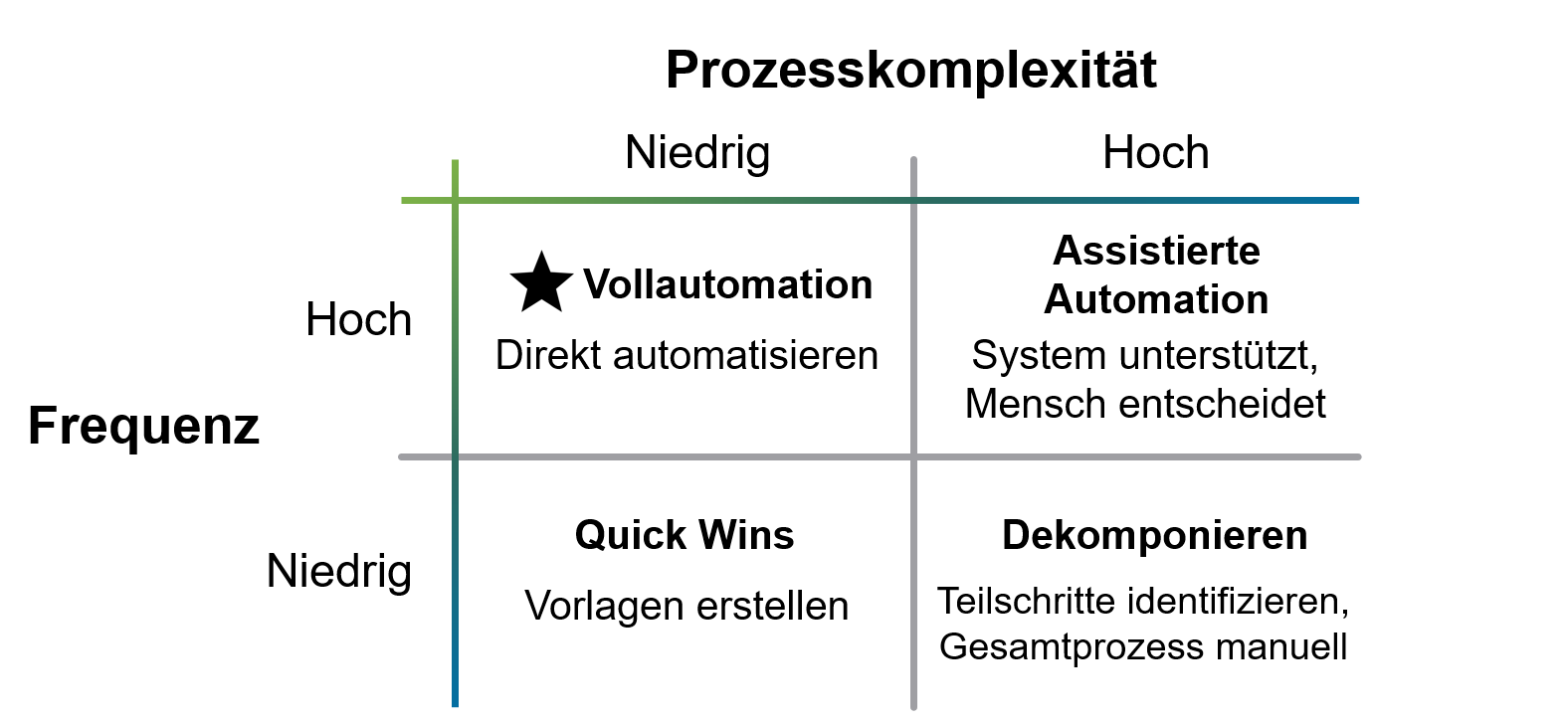
The first stage serves as a preliminary filter. Each process is classified along two dimensions:
This leads to four possible areas and recommendations for action:
Processes that appear promising in Stage 1 are evaluated in greater detail in Stage 2. To do this, each process is rated on a scale of 1 to 10 across six dimensions; the scores are then weighted individually and aggregated into a total score. The higher the score, the better suited the process is for workflow automation.
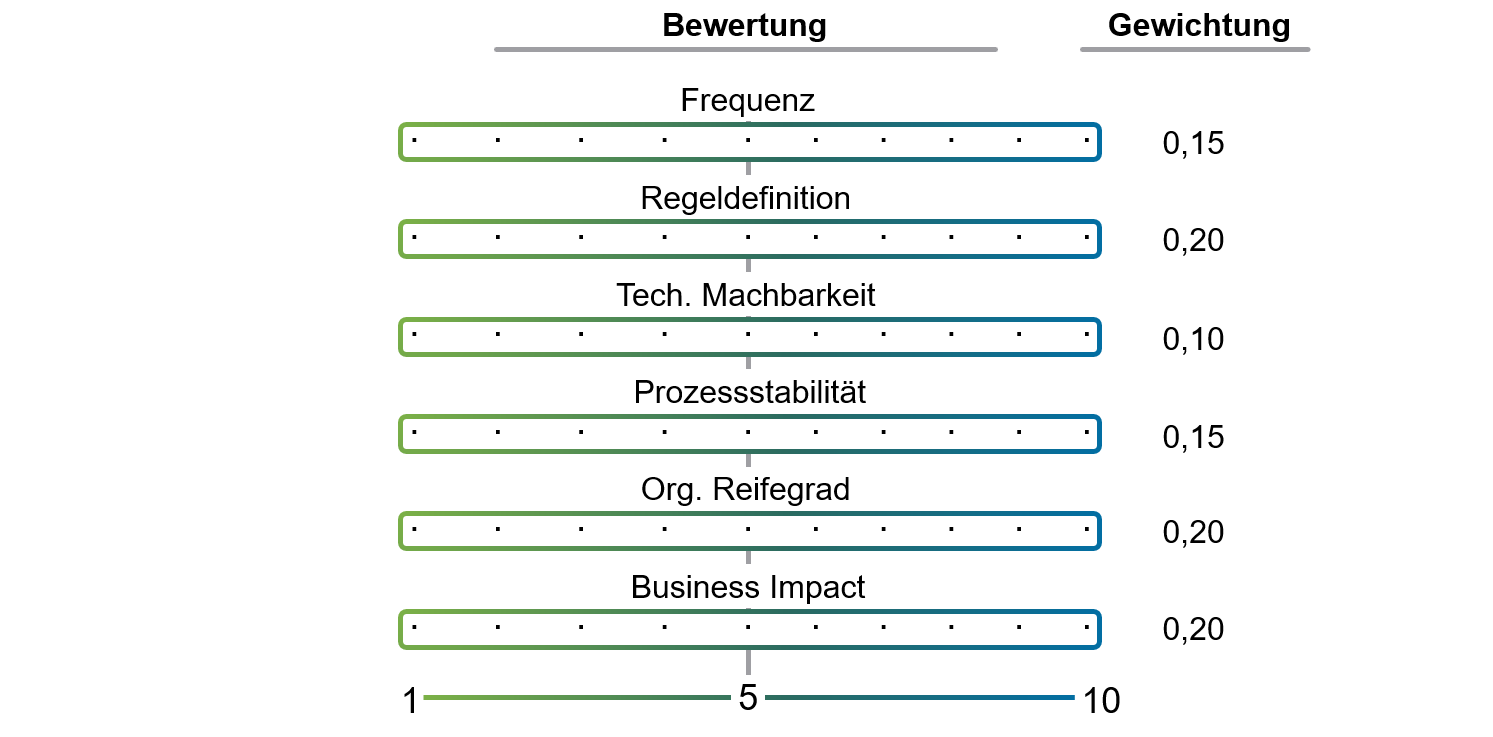
An overview of the six dimensions:
Sample weighting as a starting point:
Dimension
Frequency
Policy Definition
Technical Feasibility
Process Stability
Organizational Maturity
Business Impact
Weighting
0.15
0.20
0.10
0.15
0.20
0.20
These weightings are intentionally not a rigid model. A company facing a severe shortage of skilled workers may place greater weight on business impact, while one with a heterogeneous IT landscape may place greater weight on technical feasibility. What matters most is that the weighting is determined deliberately and discussed as a team.
The detailed evaluation does not provide a truth accurate to two decimal places, but it does force us to have the right discussion.
Dr. Clemens Wolf, Head of Digital Operations
To make the framework more tangible, we’ll classify four typical processes that are common in manufacturing SMEs and that perform particularly well in terms of quality.
In medium-sized industrial companies, incoming invoices are still frequently processed manually: Invoices arrive by mail or email, are printed out, manually posted to accounts, forwarded via internal mail, and eventually entered into the ERP system. This process, which involves a change in media, ties up resources in the accounting department and is prone to errors; at the same time, it is highly amenable to standardization.
What makes him so strong?
Depending on the complexity of the supplier base and the exception logic, the spectrum ranges from largely fully automated (“no-touch invoice”) to highly assisted automation, in which the system automatically processes standard cases while the accounting department focuses on exceptions. In both scenarios, the potential for boosting productivity and process reliability is particularly high for medium-sized industrial companies.
Complaints and quality deviations typically follow a formalized process: recording, evaluation, assignment, tracking of corrective actions, feedback, and documentation. While the technical root cause analysis remains the responsibility of the relevant department, everything else involved is a classic workflow use case.
What makes him so strong?
Since not every technical evaluation can be automated, this process is particularly well-suited for assisted automation. The system controls the workflow, and a human makes the substantive decision.
Material master data is an often-underestimated bottleneck in everyday industrial operations. New materials or changes must pass through design, purchasing, work planning, scheduling, and controlling. However, without a well-defined workflow, this leads to follow-up questions, data gaps, and delays that directly impact planning, procurement, and production.
What makes him so strong?
This process isn’t a spectacular digital topic, but it’s extremely effective from an operational standpoint. That’s exactly what makes it so attractive to small and medium-sized businesses.
Inaccurate master data not only causes systems to crash, but also disrupts actual processes in planning and production. That is precisely why a well-organized workflow is especially important here.
Dominik Fackler, Manager
When a machine is down, every minute counts. Yet in many plants, reporting, prioritization, and assignment still rely on verbal calls, phone calls, or personal habits. In fact, the process from the initial fault report to the assignment of the right maintenance technician could be automated exceptionally well.
What makes him so strong?
Of course, the actual repair is still the responsibility of the maintenance technician. But logging, assignment, and escalation are prime candidates for full automation.
A simple but effective approach can be derived from the framework:
Identify potential processes
. Ask specific questions in Purchasing, Quality, Work Planning, Maintenance, and Supply Chain about processes that involve a high degree of manual work, frequent follow-up inquiries, or long lead times.
Categorize Processes at a High Level
Use the frequency-complexity matrix to identify initial candidates and weed out obviously unsuitable processes early on.
Evaluate Processes in Detail
Evaluate your shortlist across the six dimensions and define your weightings deliberately, not haphazardly.
Starting with a clear winner
Don’t choose the most prestigious process, choose the most sensible one. Early successes build trust and facilitate further scaling.
Workflow automation delivers its greatest value not where the technology is most advanced, but where processes are clear, frequent, and effective. That is precisely why choosing the right starting point is so important. A robust prioritization model helps keep discussions objective and ensures resources are allocated strategically, so you can tackle the right process first. For manufacturing SMEs, this means less knee-jerk action and more effectiveness.
Would you like to find out which processes in your company offer the greatest potential for workflow automation? We’re here to help!

Consultant, Hamburg
Niklas Blöcker ist studierter Wirtschaftsinformatiker und Berater im Hamburger Rothbaum Office. Seine fachlichen Schwerpunkte liegen unter anderem in der Entwicklung digitaler Prozesse, Datenmigration und Sales Planning.


Manager, Munich
Dominik Fackler is a manager at Rothbaum Consulting Engineers in Munich and is responsible for transformation projects in the areas of business and system transformation. His focus is on the end-to-end optimization of business processes, as well as the selection and implementation of appropriate IT solutions.

AutoStore is one of the leading automated storage systems. Find out how the system increases…
Automated pallet warehouses offer efficient, safe and space-saving solutions for modern logistics requirements. Find out…
You don't know how good or bad you are in a particular area of the…
You need to load content from reCAPTCHA to submit the form. Please note that doing so will share data with third-party providers.
More InformationYou are currently viewing a placeholder content from Turnstile. To access the actual content, click the button below. Please note that doing so will share data with third-party providers.
More InformationYou are currently viewing a placeholder content from Facebook. To access the actual content, click the button below. Please note that doing so will share data with third-party providers.
More InformationYou are currently viewing a placeholder content from Instagram. To access the actual content, click the button below. Please note that doing so will share data with third-party providers.
More InformationYou are currently viewing a placeholder content from reCAPTCHA. To access the actual content, click the button below. Please note that doing so will share data with third-party providers.
More Information